Tarangire
Tarangire National Park is northern Tanzania's elephant stronghold — famous for some of the largest dry-season elephant concentrations in the country, ancient baobab trees and a permanent river that draws huge herds between June and October. It sits a short drive from Lake Manyara and the Ngorongoro highlands, and makes a natural first or last stop on the northern safari circuit.
Why visit
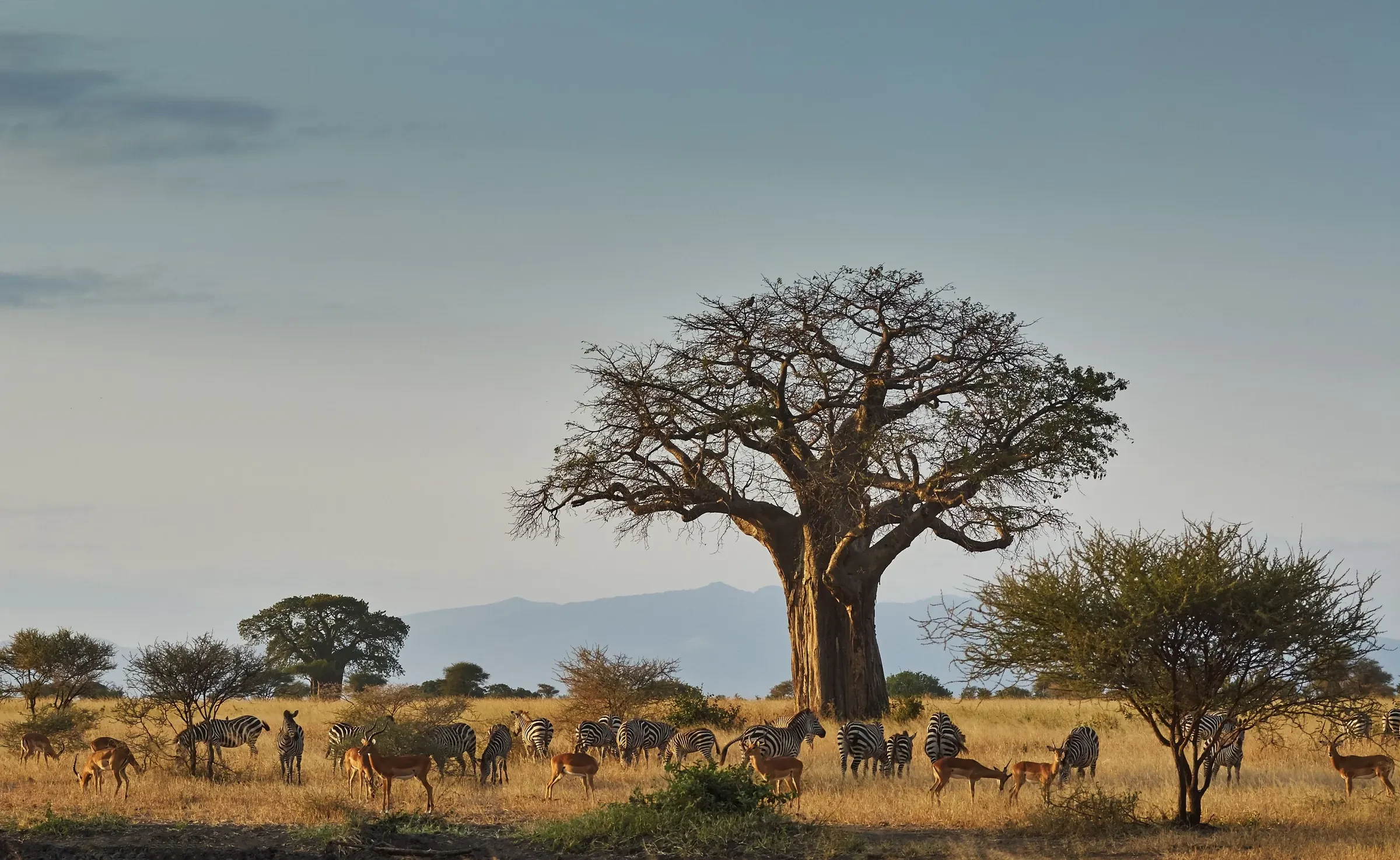
Tarangire is the northern circuit's quiet giant — often overlooked beside the Serengeti, and all the better for it. In the dry months its single permanent river becomes a lifeline, pulling in elephant herds in numbers few places in Africa can match: hundreds of animals moving through a landscape studded with baobabs so old and so vast they look less like trees than landmarks.
It is a park with a different texture from its famous neighbours — denser, more intimate, threaded with swamps and river-fed woodland rather than open plain. The light through the baobabs at dusk, the dust rising off a passing herd, the sheer age of the place: Tarangire rewards travellers who slow down.
And it is wonderfully easy to reach, sitting just off the road between Arusha and the Ngorongoro highlands — which is why it so often opens or closes a northern Tanzania journey.
Wildlife & landscapes
Tarangire is elephant country above all — the dry-season herds here are among the largest in Tanzania. The permanent Tarangire River and its swamps draw wildebeest, zebra, buffalo, giraffe and eland, with lion (including the occasional tree-resting individual), leopard and cheetah in pursuit. The park is also a birding standout, with over 500 recorded species, and home to drier-country specials like fringe-eared oryx and gerenuk at its margins. The signature landscape is the baobab-studded woodland — some trees a thousand years old — falling away to the river and seasonal swamps.
Best time to visit Tarangire
Tarangire is at its most dramatic in the dry season (roughly June–October), when the river is the only reliable water for miles and the great elephant herds — and the plains game and predators with them — concentrate along it. This is the park's headline window and the easiest game viewing. The green season (November–May) brings dispersed wildlife as water returns to the wider landscape, but spectacular birding, migratory species, newborns and lush scenery — and far fewer vehicles. For the elephant gatherings, plan for the dry season; for birds and quiet, the green months are a gift. For the wider picture, see our → Best time to visit Tanzania guide.
Things to do here
- Game drives — morning and late-afternoon drives along the river and swamps, where the herds concentrate.
- Walking safaris — on foot with an armed guide in the private concessions bordering the park (see → Walking safari).
- Night drives — in the private concessions, where after-dark game viewing is permitted.
- Birdwatching — one of Tanzania's richest parks for birds, exceptional in the green season.
- Cultural visits — encounters with Maasai communities at the park's edge.
Know before you go
- Getting there: roughly a 2-hour drive from Arusha, or a short light-aircraft hop to the park airstrip; it sits on the route toward Lake Manyara and Ngorongoro.
- Fees: national park entry fees apply (per person, per day); we confirm current rates and include them in your quote.
- How long: 1–2 nights suits Tarangire as part of a northern circuit; longer for keen birders and photographers.
Related Nobu journeys
- Northern Crater Highlands — Tarangire, the Crater and the Serengeti, the classic first safari. → Explore
- The Great Migration Circuit — Tarangire as the gentle opening to a migration journey. → Explore
When to go
Month by month — daytime warmth, days of rain and what the season brings.
Where to stay
From Essential to Private Collection — the camps and lodges we know first-hand here. Rates are indicative and confirmed on enquiry.
Signature
Lemala Mpingo Ridge
Signaturetented camp · reserve
from $450 pp / night· indicative, confirmed on enquiry
Tarangire Safari Lodge
Signaturetented camp · reserve (river)
from $250 pp / night· indicative, confirmed on enquiry
Tarangire Sopa Lodge
Signaturelodge · reserve
from $250 pp / night· indicative, confirmed on enquiry
Elevated
Little Chem Chem
Elevatedtented camp · private concession (Burunge WMA)
from $700 pp / night· indicative, confirmed on enquiry
Oliver's Camp (Asilia)
Elevatedtented camp · reserve
from $700 pp / night· indicative, confirmed on enquiry
Sanctuary Swala
Elevatedtented camp · reserve
from $600 pp / night· indicative, confirmed on enquiry
Tarangire Treetops
Elevatedlodge · reserve-adjacent
from $650 pp / night· indicative, confirmed on enquiry
Private Collection
Chem Chem Lodge
Private Collectionlodge · private concession (Burunge WMA)
from $1,100 pp / night· indicative, confirmed on enquiry
Journeys through here
Signature routes that pass through Tarangire — starting points we reshape around your season and pace.
Common questions
- When is the best time to visit Tarangire?
- The dry season, roughly June to October, when the elephant herds and plains game concentrate along the river; the green season (November–May) is quieter and superb for birding.
- Why is Tarangire famous for elephants?
- Its permanent river is the dry-season lifeline for a large landscape, drawing some of the biggest elephant concentrations in Tanzania to its banks.
- How many days do you need in Tarangire?
- One to two nights fits it neatly into a northern circuit; add a night if you're a keen birder or photographer.
- Can you combine Tarangire with the Serengeti and Ngorongoro?
- Yes — Tarangire sits on the same northern route and most often opens or closes a Serengeti-and-Crater journey.
Tell us what you want from Tarangire
We'll design the journey around it — places, pace and people matched to how you travel.