Ruaha
Ruaha National Park is Tanzania's largest national park, set in the remote south of the country around the lifeline of the Great Ruaha River. It holds some of Africa's most impressive elephant populations, large lion prides, one of the continent's best strongholds for the endangered African wild dog, and a rugged, baobab-studded landscape where East and Southern African wildlife species overlap — sable, roan and greater kudu alongside the plains game of the north. It is remote by design, and that remoteness is precisely the point.
Why visit
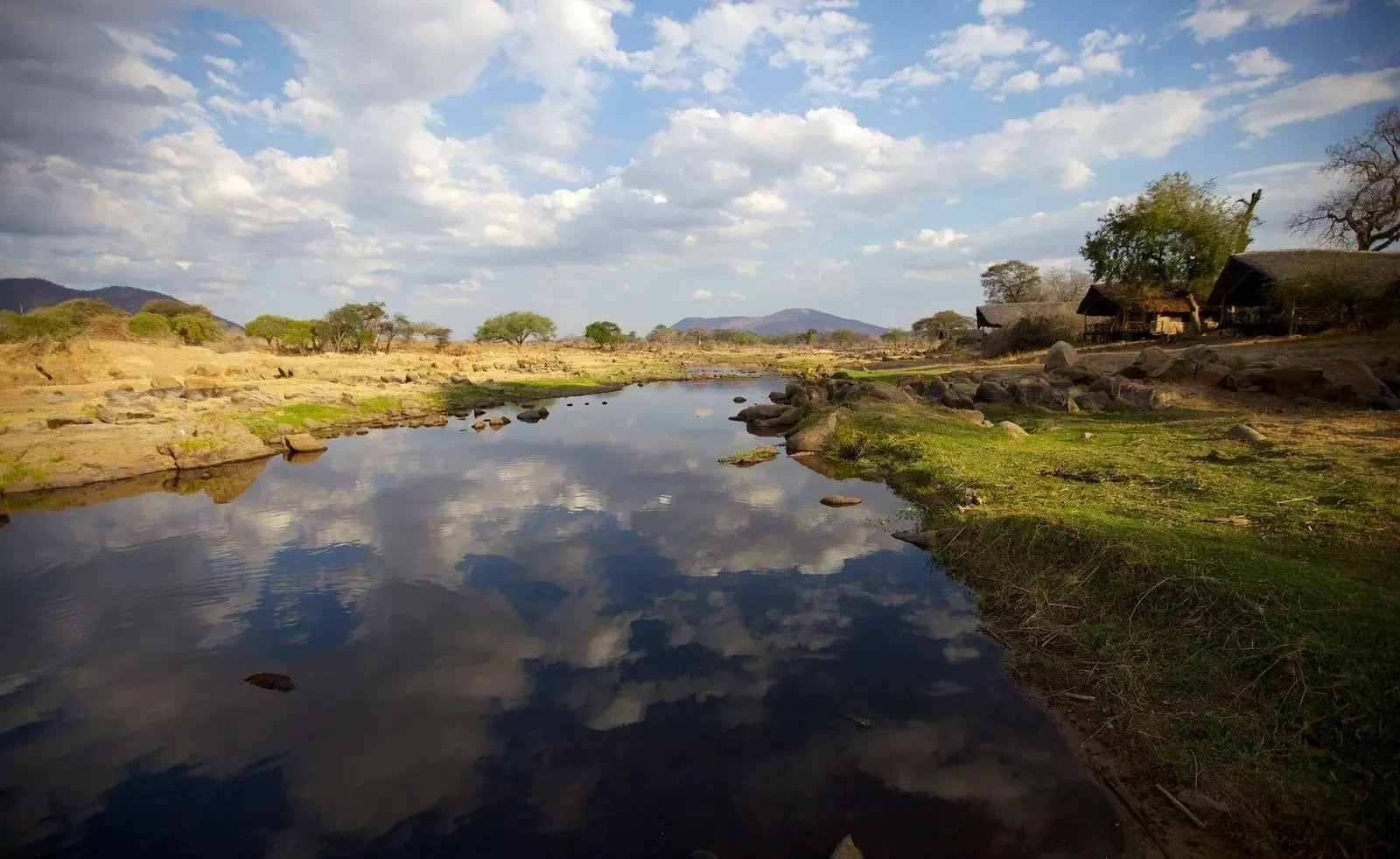
There is a kind of silence in Ruaha that the northern circuit does not offer. Tanzania's largest national park sprawls across the south-central interior — rugged, enormous, and genuinely far from the nearest tarmac. The baobabs here are old and enormous. The kopjes glow in late afternoon light. The Great Ruaha River, in the dry months, becomes the single thread that every animal in the landscape follows, and if you find a good stretch of bank and wait, the dry season makes the river do the work.
This is a park for travellers who have felt the northern circuit's pull and want to go deeper — or who simply want to arrive somewhere that feels genuinely earned. Vehicle counts are a fraction of the Serengeti's. Encounters are not arranged around other Land Cruisers. What you find here, you often find alone.
The southern circuit's logic is compelling: Ruaha pairs naturally with Nyerere for a two-park immersion in Tanzania's wild south, and both are accessible by light aircraft, making a fly-in bush journey possible without a long road transfer. For those who want the depth of East Africa without its busiest stages, Ruaha is where to begin.
Wildlife & landscapes
The Great Ruaha River is the dry-season axis around which everything turns — elephant, buffalo, lion, leopard, zebra and waterbuck all concentrate on its banks as the surrounding bush dries out, and the game-viewing can be extraordinary. Ruaha holds one of Tanzania's largest elephant populations; herds are large, close, and frequent.
Lion prides are strong and, by the dry months, reliably trackable along the river. Leopard move through the riverine thicket and rocky outcrops. And then there is the park's signature: Ruaha is one of Africa's most important refuges for the African wild dog — a pack-living, coursing predator that is among the continent's most endangered carnivores, and one of the most electric things in the bush to witness. Sightings are never guaranteed, but the chances here rank among the best on the continent.
What separates Ruaha from any park to the north is its character as a transition zone between East and Southern Africa. Greater and lesser kudu, sable and roan — the great antelopes of the southern spectrum — live here alongside the more familiar plains species. The landscape itself is a mix: miombo woodland, open floodplain, rocky escarpment and stands of ancient baobab against a sky that feels wider than anywhere else in Tanzania.
Best time to visit Ruaha
The dry season, roughly June through October and into November, is the headline period. As the bush dries and water recedes, wildlife concentrates along the Great Ruaha River in numbers that reward patience — this is when game-viewing is at its most reliable and walking conditions are at their best. Elephant gatherings at the river in late dry season can be among the most affecting sights in Africa.
The green season (November–May) brings lush landscapes, dramatic skies and exceptional birdlife — Ruaha's bird list is significant, and the wetter months swell it further. Some camps reduce operations or close entirely in the heaviest rains, typically around March to May; arrival options narrow and some areas become hard to reach. For the widest camp choice and the most concentrated game, plan for the dry season. For quieter conditions, lower rates and the birding at its richest, the green season has a strong case. For the full seasonal picture across Tanzania, see our → Best time to visit Tanzania guide.
Things to do here
- Game drives — morning and late-afternoon drives along the Ruaha River and through miombo and floodplain, tracking lion, wild dog and elephant in very low vehicle counts.
- Walking safaris — on foot with an armed guide through one of East Africa's wildest landscapes, reading tracks and signs at ground level (see → Walking safari).
- Night game drives — where camps and the park permit them, revealing the nocturnal side of a landscape that changes character entirely after dark (see → Night game drive).
- Photographic safaris — Ruaha's light, its vast landscapes and the intimacy of its wildlife encounters make it an outstanding location for serious photography; the low vehicle density is a particular advantage (see → Photographic safari).
- Birding — over 570 recorded species, including Ruaha's transition-zone specials, make this one of Tanzania's finest birding destinations (see → Birding safari).
Know before you go
- Getting there: access is by light aircraft, typically via Dar es Salaam or as part of the southern circuit (Dar–Ruaha or Nyerere–Ruaha in combination); Ruaha has its own airstrips served by scheduled and charter flights. There is no practical road alternative for most visitors.
- Fees: national park entry fees apply (per person, per day); we confirm current rates and include them in your quote.
- How long: 3–4 nights does Ruaha justice and makes the flight in worthwhile; combine with Nyerere for a complete southern-circuit journey, or finish with Zanzibar for a bush-and-beach arc.
Related Nobu journeys
- Wild South Expedition — Ruaha and Nyerere by vehicle and on foot, far from the northern crowds. → Explore
- Southern Safari & Spice — the wild south paired with Zanzibar for bush and beach. → Explore
- Bush to Beach — from the remote interior to the Swahili Coast, a natural Tanzania arc. → Explore
When to go
Month by month — daytime warmth, days of rain and what the season brings.
Where to stay
From Essential to Private Collection — the camps and lodges we know first-hand here. Rates are indicative and confirmed on enquiry.
Essential
Tandala Tented Camp
Essentialtented camp · reserve-adjacent
from $200 pp / night· indicative, confirmed on enquiry
Signature
Mdonya Old River Camp
Signaturetented camp · reserve
from $300 pp / night· indicative, confirmed on enquiry
Ruaha River Lodge
Signaturelodge · reserve riverfront
from $300 pp / night· indicative, confirmed on enquiry
Expedition
Kichaka Expeditions Camp
Expeditiontented camp · reserve
from $700 pp / night· indicative, confirmed on enquiry
Usangu Expedition Camp
Expeditiontented camp · reserve
from $700 pp / night· indicative, confirmed on enquiry
Elevated
Ikuka Safari Camp
Elevatedtented camp · reserve
from $600 pp / night· indicative, confirmed on enquiry
Jongomero Camp
Elevatedtented camp · reserve riverfront
from $700 pp / night· indicative, confirmed on enquiry
Kigelia Ruaha
Elevatedtented camp · reserve
from $600 pp / night· indicative, confirmed on enquiry
Mwagusi Safari Camp
Elevatedtented camp · reserve riverfront
from $600 pp / night· indicative, confirmed on enquiry
Private Collection
Jabali Ridge
Private Collectionlodge · reserve
from $900 pp / night· indicative, confirmed on enquiry
Kokoko Camp
Private Collectiontented camp · reserve
from $800 pp / night· indicative, confirmed on enquiry
Journeys through here
Signature routes that pass through Ruaha — starting points we reshape around your season and pace.
Common questions
- When is the best time to visit Ruaha?
- The dry season, roughly June to October, when wildlife concentrates on the Great Ruaha River and walking is at its best; some camps close in the heaviest rains around March to May.
- Can you see African wild dogs in Ruaha?
- Ruaha is one of Africa's strongest populations of the endangered African wild dog, so sightings are a genuine possibility — particularly in the dry season when packs range more predictably. As with all wildlife, they are never guaranteed, but the chances here are among the best on the continent.
- How does Ruaha compare to the Serengeti or Maasai Mara?
- Ruaha is Tanzania's southern circuit — wilder, more remote, and with a fraction of the vehicle count of the northern parks. It lacks the great migration but delivers exceptional elephant and predator viewing, unique southern-African antelope species, and an atmosphere of genuine wilderness that the north's busiest stages cannot match.
- What makes Ruaha different from Nyerere (Selous)?
- Both are southern-circuit parks with low vehicle density and wild-dog populations, but the two feel distinct: Nyerere is defined by the Rufiji River and its boat safaris; Ruaha is a drier, more rugged landscape of baobab and miombo woodland, with the Great Ruaha River as its dry-season anchor. They pair beautifully together as a two-park southern journey.
- How many days do you need in Ruaha?
- Three to four nights lets you experience the river at different times of day, cover varied terrain and absorb the park's pace without rushing; longer if wild dog tracking is a priority.
Tell us what you want from Ruaha
We'll design the journey around it — places, pace and people matched to how you travel.