Start here
Last checked: October 2026.
Kenya and Tanzania share one ecosystem, one pair of rainy seasons and, for most of the year, one answer. The Maasai Mara and the Serengeti are the same grassland on either side of a border, so a month that suits one almost always suits the other. That makes a two-country trip easier to time than a one-country trip with a beach attached.
This page is the planning view: which months work for both, how to order the countries, and what changes if you add Zanzibar. It does not repeat each country's regions. For those, see the best time to visit Kenya and the best time to visit Tanzania; for the herds, the great migration month by month; and for choosing one country over the other, Kenya vs Tanzania.
The detail
The rains line up. Kenya's long rains fall from March to May, heaviest in April, and its short rains from about October to December. Northern Tanzania runs the same pattern under local names: the Masika from March to May and the Vuli from October to December. Because the calendars match, you do not trade one country's dry weather for the other's wet weather. You choose between dry, green and shoulder months for both at once.
The year at a glance, for both countries together.
| Month | Weather in both | What the combined trip gains | What to weigh |
|---|---|---|---|
| January | Dry, warm | Southern Serengeti calving builds; Mara resident game | Busy to about 5 January, then quieter |
| February | Dry | Calving usually peaks around Ndutu; Amboseli and the Kenya coast settled | Fine for beach finishes |
| March | Rains begin | Last of the calving; green and quiet | Some tracks soften; lower rates start |
| April | Long rains | Fewest vehicles; lowest camp rates | Wettest month; some seasonal camps close |
| May | Long rains | Western corridor movement begins; very few visitors | Kenya's coast is at its wettest |
| June | Drying out | Quieter than July; herds mostly still in the western Serengeti; roads firming | Mara fee still at its lower level |
| July | Long dry | Herds reach the northern Serengeti; first Mara crossings usually late July | Busy; Mara fee switches to US$200 on 1 July |
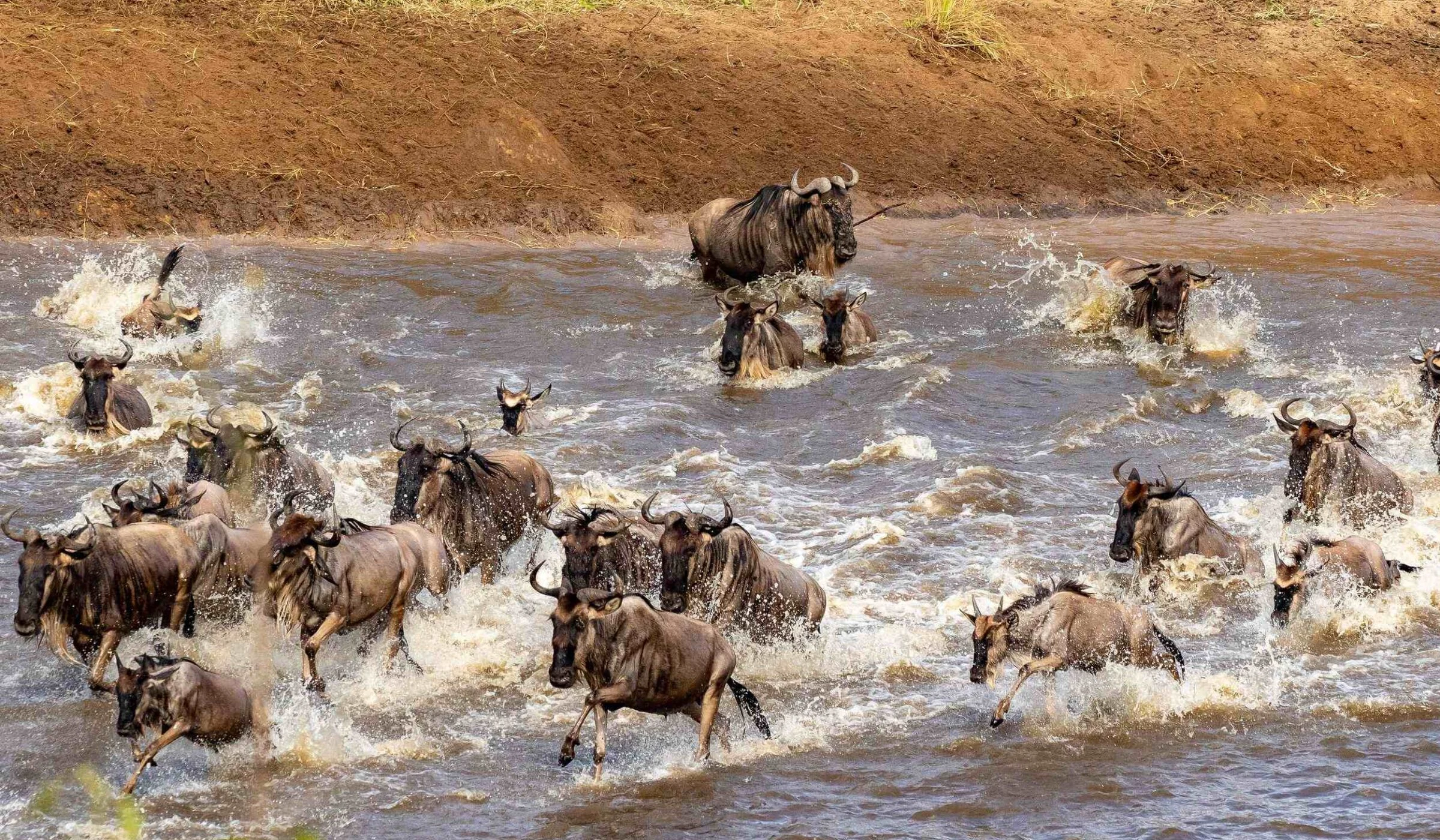
| August | Long dry | River crossings most reliable | Busiest month on both sides |
| September | Long dry | Crossings continue; busy but a little quieter | A good compromise month |
| October | Dry, then rains begin | Dry early in the month; herds start south | Short rains often start mid-month |
| November | Short rains | Green, dramatic skies, fewer vehicles | Showers most days in some areas |
| December | Short rains, then dry | Dry again by the festive weeks in most years | Peak demand 20 December to 5 January |
The table is our own reading of the official rain calendars and the herd's usual route, not a published ranking.
How to rank them. For a first two-country trip, July to September gives the most reliable game and the herds' most active weeks, and costs the most. June and October are the shoulders: quieter, and still mostly dry. January and February suit travellers who want calving, warmer weather and the coast, and who would rather not share the Mara in August. April and May suit a second visit, or a traveller who values space over certainty. Crossings draw dozens of vehicles to a few points on the Mara River (one 2022 account counted about 60 waiting near the banks); a private conservancy base or a September date eases that, and good guides hold back from the riverbank.
How to order the two countries. Order by where the main event is and where you fly home, and finish at the main event when you can. Between July and September the herds cross on both sides of the border, so either order works and the flight home decides: home from Nairobi, start in Tanzania; home from Arusha, Kilimanjaro or Dar es Salaam, start in Kenya. In January and February the calving is in Tanzania's south, so end there, with a lighter Kenyan stop first.
Getting between them. We route guests between the Mara and the Serengeti via Nairobi. Going south, a bush flight takes you to Nairobi's Wilson Airport, where you leave Kenya; AirKenya Express flies you to Arusha in about 55 minutes, and you spend the night near Arusha before a morning bush flight into the Serengeti. The scheduled flight does not run from about 1 April to 20 May or from 1 November to 15 December; in those months we arrange a charter. Going north, you fly from the Serengeti to Arusha and on to Nairobi, spend the night there, and fly to the Mara the next morning. Either way, allow a full day. A scheduled border-post route also exists; we do not use it. We plan this route as our Kenya and Tanzania safari; ask us for the leg-by-leg version. Both countries ask for entry paperwork: see the Kenya entry requirements and the Tanzania visa guide.
Fees follow different calendars. The weather season and the fee season are not the same. The Maasai Mara reserve fee is an annual switch, not a one-off rise: US$100 per adult per day from 1 January to 30 June, US$200 from 1 July to 31 December (Narok County's published rates, as reported). Tanzania's national parks authority, TANAPA, publishes a low season from 15 March to 15 May for the Serengeti, Tarangire and Manyara, with peak rates for the rest of the year, in its last published tariff (2023/24). Camp seasons are set by each operator. A trip in late June or in October can sit in the lower band on one side of the border and the higher on the other, which is worth knowing when you compare totals. Costs in full are in our safari cost guide.
Zanzibar at the end. Add the island last, as the rest after the dust. Zanzibar's dry months are roughly June to October and December to February; its long rains fall from March to May, and many hotels close for part of April and May. The sea is warm all year. The two windows also line up with the safari: June to October fits the dry-season safari, and January to February fits a calving trip. See the best time to visit Zanzibar.
A note for late 2026. Kenya's forecasters expect above-average short rains in most counties, including Narok (the Mara) and Kajiado (Amboseli), possibly continuing into January 2027 during a strong El Niño. Tanzania's weather agency forecast above-normal Vuli rains too, including on Zanzibar. If you travel between now and February 2027, expect more rain than the usual calendar suggests, and we plan around the latest forecast.
Key facts
Best months for both countries: late June–October. Second window: January–February. Weakest months to combine: April–May (long rains in both). Long rains: March–May. Short rains: about October–December. Mara River crossings: most reliable August–September. Calving: southern Serengeti, late January–March, usually peaking in February. Fee seasons: Mara fee US$100 January–June, US$200 July–December; TANAPA low season 15 March–15 May. Zanzibar: dry June–October and December–February. Late 2026: above-average short rains forecast in both countries.
Planning it with Nobu
Timing a two-country trip is mostly about sequence: which way you travel between them, which fee season you land in, which camps are open that month. We plan the order around your dates and the flights between, then say plainly if a month is a poor fit. If a single country suits your dates better, we say that too.
Is it right for you?
July to September is right for you if the herds are the point and you accept the busiest weeks and highest rates. January to February is right for you if calving, warm weather and a beach finish appeal more than the river crossings. June and October are right for you if you want mostly dry weather with fewer vehicles. April and May are right for you if you value space and lower rates and accept mud and closed camps. Choose one country if you have fewer than seven nights. With seven to nine nights both countries are possible but tight: three nights each and the travel day leave little slack. If you are unsure, start with Kenya vs Tanzania.
Journeys to consider
- Tanzania, one chapter at a time. — Eight days in northern Tanzania, best June to October and January to February. Tanzania, one chapter at a time.
- The Mara, unhurried. — Five days in the Mara, best July to October. The Mara, unhurried.
- Zanzibar, with nothing to rush. — Seven days on the island, best June to October and December to February. Zanzibar, with nothing to rush.