Stone Town
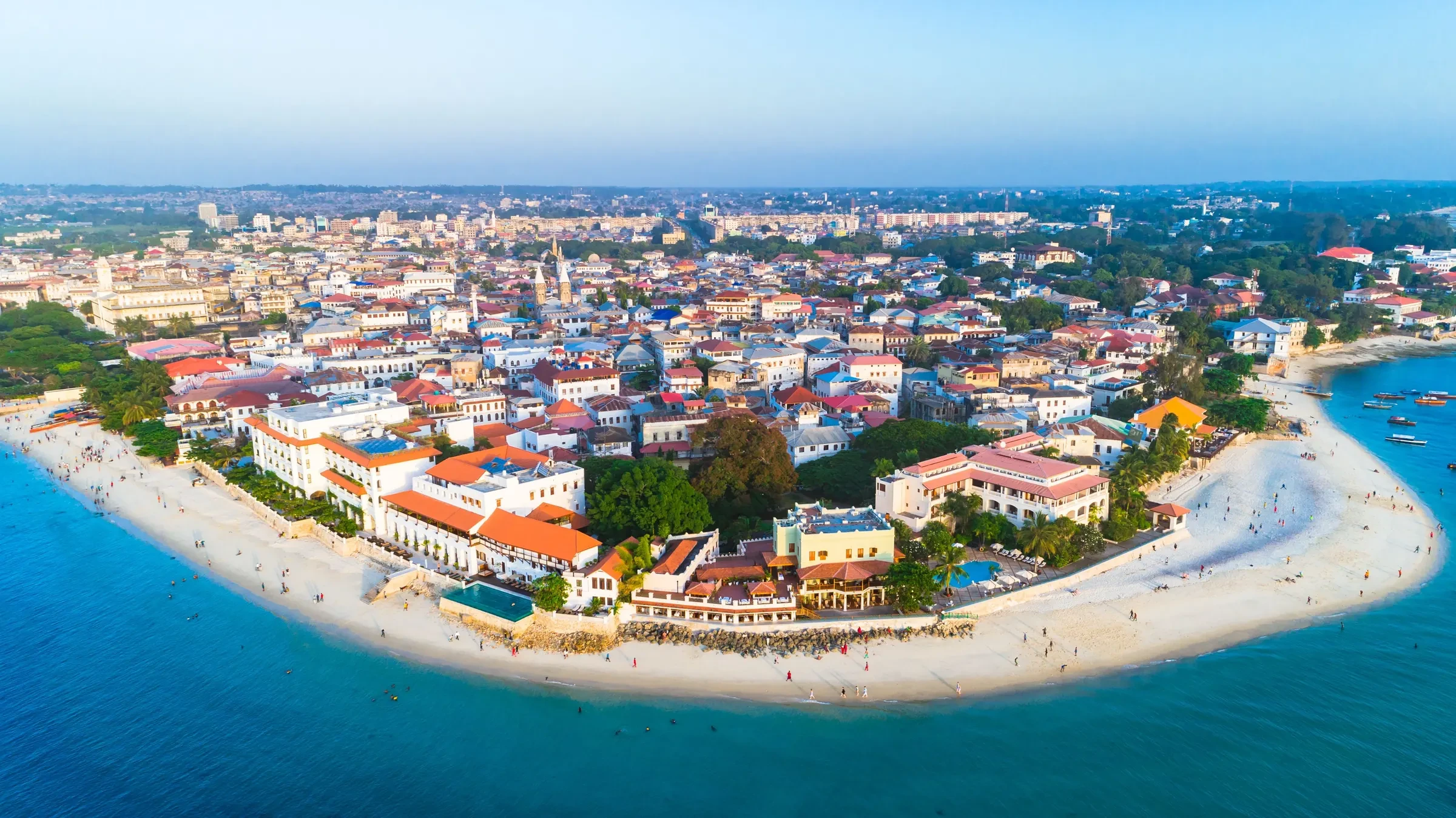
Stone Town is the historic heart of Zanzibar City on Unguja island, Tanzania — a UNESCO World Heritage Site and one of the finest surviving Swahili coastal trading towns. Its coral-stone alleys hold layers of African, Arab, Indian and European history: carved wooden doors, the old spice and slave trades, the House of Wonders, and Freddie Mercury's birthplace. It is a heritage city rather than a beach, and the natural arrival point and cultural anchor of almost every Zanzibar itinerary.
Why visit
Stone Town is where Zanzibar's whole story is written in stone and shadow. For centuries this was one of the great crossroads of the Indian Ocean — a place where Swahili traders, Omani sultans, Indian merchants and European powers all left their mark, and where the trade in spices and, darkly, in enslaved people once passed through the same narrow lanes. Walking it today is less sightseeing than immersion: you lose yourself deliberately, turn a corner, and the centuries turn with you.
The city rewards the wanderer. There is no grid, only a coral-stone maze of alleys too tight for cars, opening without warning onto a mosque, a Hindu temple, a courtyard, a crumbling merchant's mansion. Above you, the famous carved doors — brass-studded, Arab-arched or Indian-lintelled — mark the wealth and faith of whoever once lived behind them.
And then the waterfront exhales. As the sun drops, the Forodhani gardens fill with grills and lantern-light, dhows lean at anchor, and the whole town seems to gather at the edge of the sea it was built to face.
Historic city, waterfront & spice-farm hinterland
The draw at Stone Town is human, not wild — this is a living UNESCO World Heritage Site, and the "landscape" is the historic urban fabric itself. Its signature is the carved wooden doors, hundreds of them, their brass studs and geometric or floral carving reading like a directory of the town's Arab, Indian and Swahili merchant past. The great landmarks anchor it: the House of Wonders (Beit-al-Ajaib), the seafront Old Fort, the Anglican cathedral raised on the site of the old slave market — a sober, essential reckoning with the town's darkest chapter — and, for many visitors, the modest house recorded as Freddie Mercury's birthplace.
The waterfront is the town's other face. The Forodhani night food market turns the harbour-front gardens into an open-air kitchen after dark — Zanzibari pizza, grilled seafood, sugarcane juice — while dhows and fishing boats crowd the anchorage beyond.
Inland lies the hinterland that gave the island its name: the spice farms of the interior, where clove, nutmeg, cinnamon, vanilla and cardamom grow within an easy drive. A guided spice tour is the classic half-day, and one of the most sensory experiences on Unguja.
Best time to visit
Zanzibar runs on the monsoon, not the safari calendar. The dry season from June to October is the most comfortable window for walking the town — clear skies, lower humidity, and cool enough to spend hours in the alleys. December to February is warm and largely dry, another fine period, though busier around the turn of the year.
The long rains (March to May) bring heavy, humid downpours that make the tight lanes steamy and slow, while the short rains around November are lighter and more intermittent. Because Stone Town is an indoor-and-alley city rather than a beach, it stays worthwhile in shoulder seasons when open coast feels exposed. For full detail — and for timing a Stone Town stop against a mainland safari — see our → Best time to visit Zanzibar guide.
Things to do here
- Guided old-town walk — the essential introduction: carved doors, the Old Fort, the House of Wonders, temples and mosques side by side, with a guide to read the layers.
- Slave market & Anglican cathedral — a considered, respectful visit to the memorial on the site of the former market; the moral centre of any honest Stone Town day.
- Forodhani night market — grazing the harbour-front food stalls after dusk, one of the town's defining evenings.
- Spice-farm tour — a half-day into the hinterland to see, smell and taste clove, nutmeg, cinnamon and vanilla at the source.
- Dhow sunset sail — the harbour turns gold as traditional dhows lean into the light (see → Dhow and the Swahili Coast).
- Prison Island excursion — a short boat hop to Changuu, its old quarantine buildings and a colony of giant Aldabra tortoises.
Know before you go
- Getting there: Fly into Zanzibar International Airport (ZNZ), which receives direct flights from Nairobi, Dar es Salaam and other East African hubs. Stone Town sits on the west coast beside the airport — transfers run roughly 15 to 30 minutes by road. It is also the ferry port for the crossing from Dar es Salaam.
- Entry and fees: Tanzania visa requirements apply; entry fees for individual monuments and spice tours are arranged locally — we confirm current requirements and they are confirmed in your quote.
- How long: 1 to 2 nights suits Stone Town as a cultural arrival or finale; longer if you want to slow into the town and its spice hinterland. It pairs naturally with a beach on the north or east coast, and with a mainland Tanzania or Kenya safari.
- Character note: the old town is a working, Muslim-majority city — modest dress in the alleys and mosques is appreciated, and it is easy (and part of the pleasure) to get lost.
Related Nobu journeys
- Shores of Zanzibar — the island's layered story, from Stone Town's alleys to the reef and the dhow. → Explore
- Southern Safari and Spice — the southern Tanzania parks paired with Zanzibar's coast and culture. → Explore
- Bush to Beach — the classic pairing: safari on the plains, then the Indian Ocean and its spice island. → Explore
When to go
Month by month — daytime warmth, days of rain and what the season brings.
Where to stay
From Essential to Private Collection — the camps and lodges we know first-hand here. Rates are indicative and confirmed on enquiry.
Essential
Forodhani Park Hotel
Essentialhotel · urban
from $50 pp / night· indicative, confirmed on enquiry
Signature
Dhow Palace Hotel
Signaturehotel · urban
from $80 pp / night· indicative, confirmed on enquiry
Kholle House
Signatureboutique · urban
from $120 pp / night· indicative, confirmed on enquiry
Maru Maru Hotel
Signaturehotel · urban
from $100 pp / night· indicative, confirmed on enquiry
Tembo House Hotel
Signaturehotel · urban
from $90 pp / night· indicative, confirmed on enquiry
The Seyyida Hotel & Spa
Signaturehotel · urban
from $120 pp / night· indicative, confirmed on enquiry
The Swahili House
Signatureboutique · urban
from $80 pp / night· indicative, confirmed on enquiry
Zanzibar Coffee House
Signatureboutique · urban
from $70 pp / night· indicative, confirmed on enquiry
Zanzibar Serena Hotel
Signaturehotel · urban
from $200 pp / night· indicative, confirmed on enquiry
Elevated
Emerson on Hurumzi
Elevatedboutique · urban
from $180 pp / night· indicative, confirmed on enquiry
Emerson Spice Hotel
Elevatedboutique · urban
from $180 pp / night· indicative, confirmed on enquiry
Jafferji House & Spa
Elevatedboutique · urban
from $150 pp / night· indicative, confirmed on enquiry
Park Hyatt Zanzibar
Elevatedhotel · urban
from $350 pp / night· indicative, confirmed on enquiry
Zanzibar Palace Hotel
Elevatedboutique · urban
from $140 pp / night· indicative, confirmed on enquiry
Journeys through here
Signature routes that pass through Stone Town — starting points we reshape around your season and pace.
Experiences here
Common questions
- Why is Stone Town a UNESCO World Heritage Site?
- It is one of the best-preserved Swahili coastal trading towns in East Africa, where African, Arab, Indian and European influences fused over centuries into a single urban fabric — its carved doors, coral-stone architecture and layered history earned World Heritage status.
- How many days do you need in Stone Town?
- One to two nights is enough to walk the old town, see the key landmarks and take a spice tour; most travellers use it as a cultural arrival or finale and spend the rest of their time on the coast.
- What is there to do in Stone Town besides the old city?
- Beyond the alleys, carved doors and slave-market memorial, the classic add-ons are a spice-farm tour in the hinterland, the Forodhani night food market, a dhow sunset sail, and a boat hop to Prison Island's giant tortoises.
- Is Stone Town a beach destination?
- No — Stone Town is a heritage city on the west coast, Zanzibar's cultural and historic heart. For beaches you move to the north or east coast; most journeys combine the two.
- How far is Stone Town from Zanzibar airport?
- Very close — the transfer is roughly 15 to 30 minutes by road from Zanzibar International Airport (ZNZ), which makes Stone Town the natural first or last stop of a Zanzibar itinerary.
Tell us what you want from Stone Town
We'll design the journey around it — places, pace and people matched to how you travel.