Serengeti, Kogatende North
Serengeti, Kogatende North is a safari area in Tanzania. We currently track 4 places to stay here. Access is usually via Kogatende Airstrip. It works best when the route gives it a clear purpose: arrival, wilderness, coast, culture, rest or a better-paced connection between larger stops.
Why visit
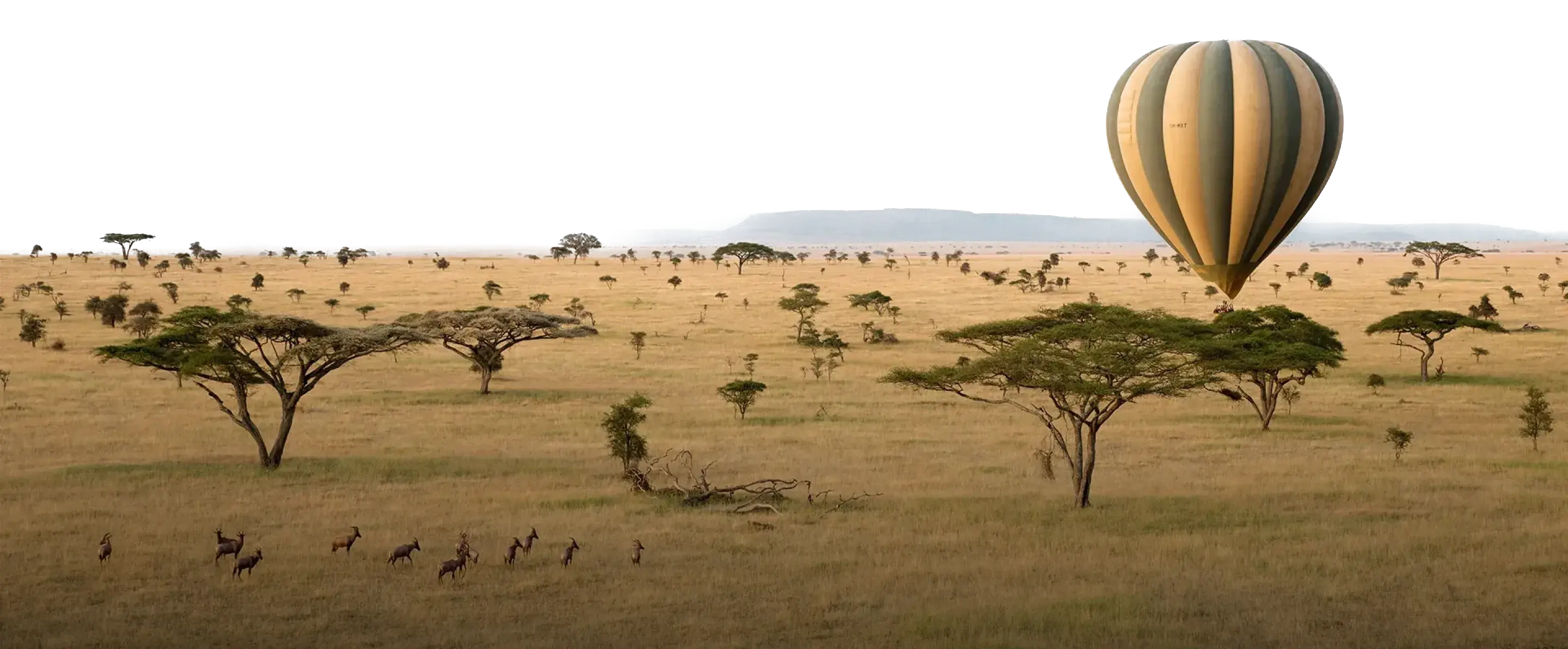
The Serengeti is the plain against which all other plains are measured. Its name comes from the Maa siringet — "the place where the land runs on forever" — and that is exactly what the eye is given: grassland to every horizon, broken only by flat-topped acacia and the grey domes of ancient granite kopjes. This is the stage for the greatest animal migration left on earth.
But the migration is a circle, not a season, and the Serengeti is never empty. Even when the herds have moved on, the park holds some of the richest resident wildlife in Africa — lion prides on the kopjes, cheetah on the short grass, leopard in the river fig trees. Where you go in the Serengeti depends on the month, and a well-timed journey puts you exactly where the action is.
It is also a park of distinct regions — the short-grass south, the central Seronera valley, the western corridor and the wild north — each with its own character and its own moment in the migration year.
Wildlife & landscapes
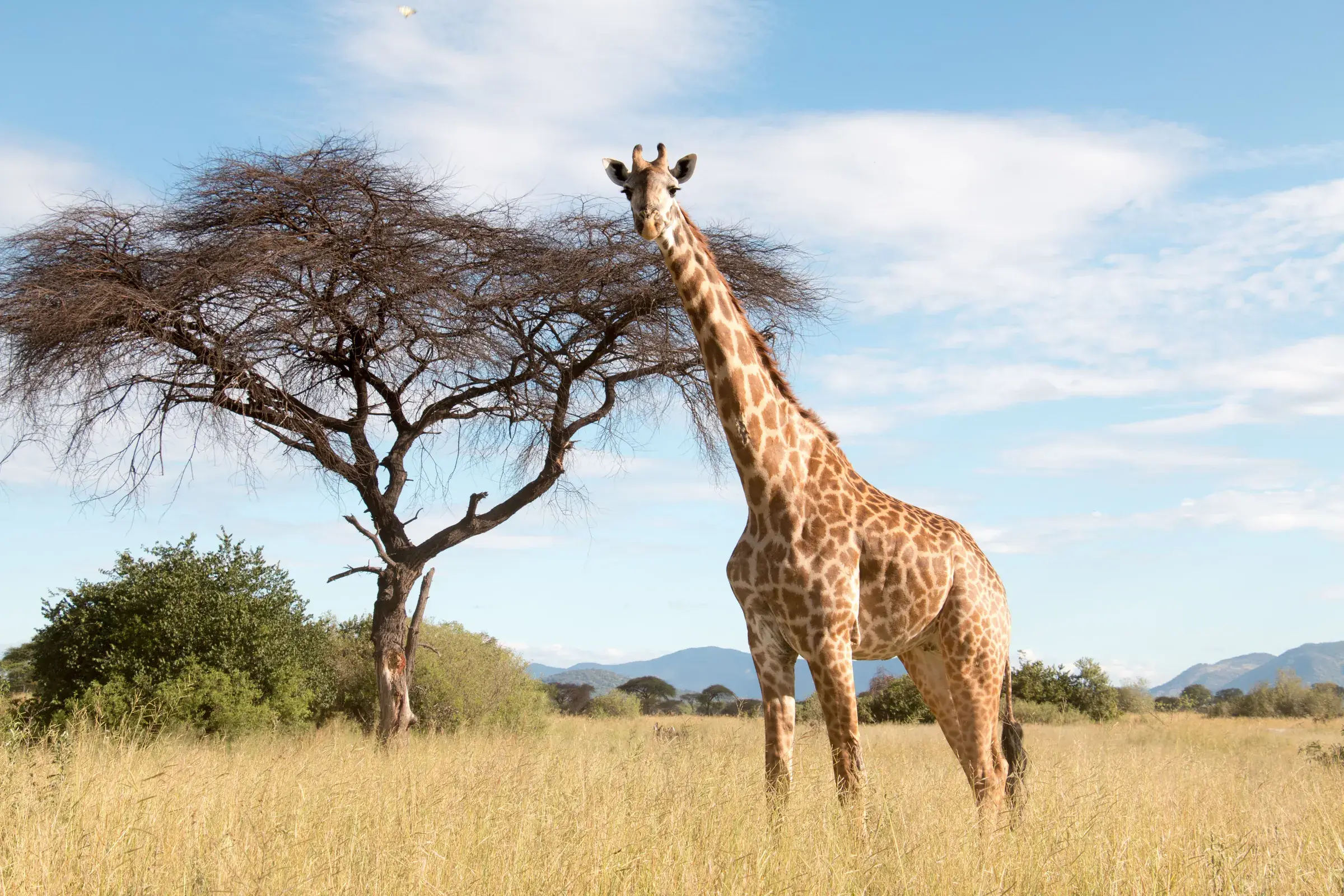
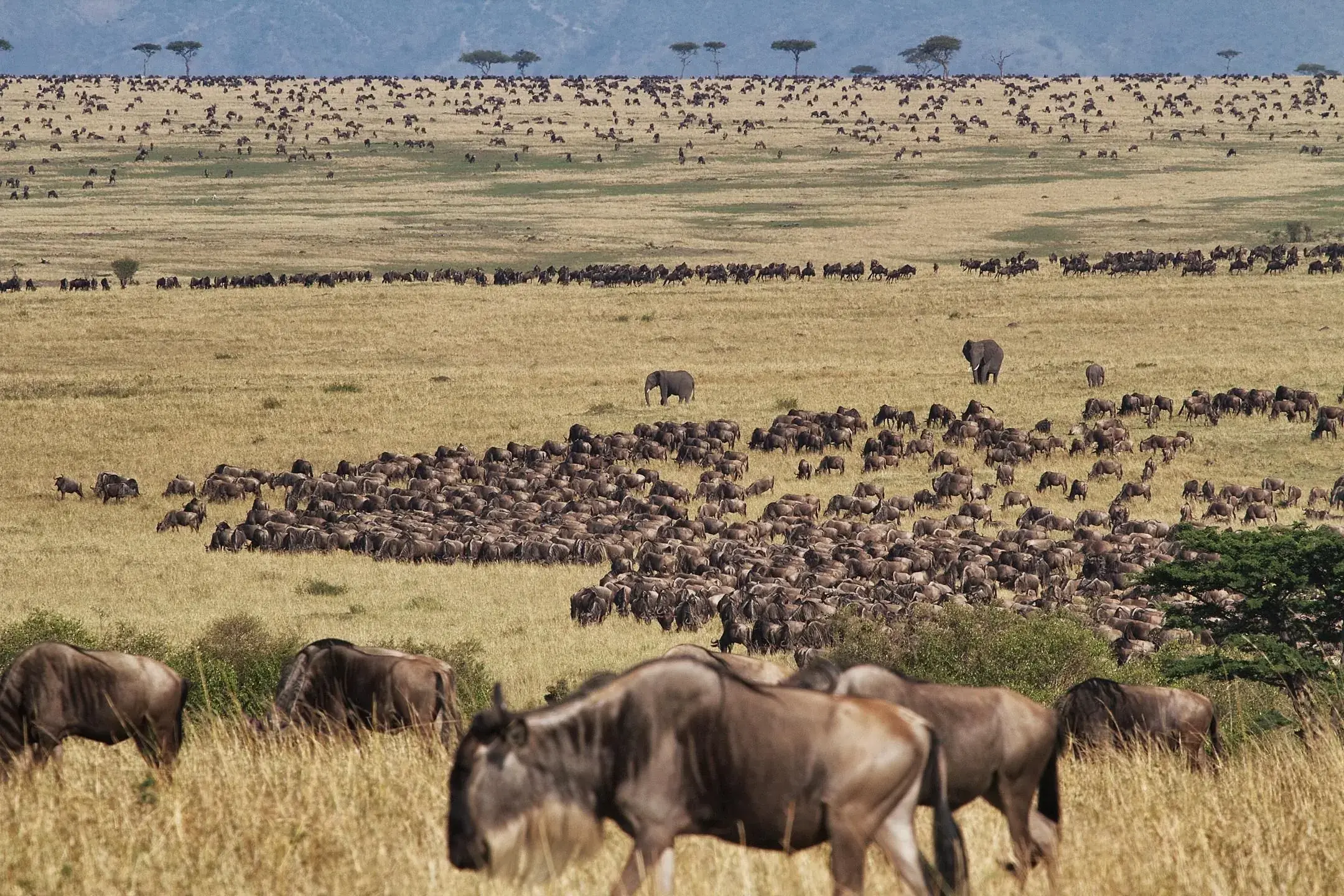
The headline is the migration — close to two million wildebeest with zebra and gazelle, following the rains in a year-round loop. But the Serengeti is a Big Five park and superb big-cat country: outstanding lion density, strong cheetah on the open plains, and leopard along the wooded watercourses. Add elephant, buffalo, giraffe, hippo and crocodile in the rivers, and black rhino — present but scarce, mostly in the Moru area. The landscape ranges from the treeless southern short-grass plains to the kopje-studded centre, the riverine Grumeti west, and the rolling north where the Mara River runs down from Kenya. It adjoins the Maasai Mara across the border — one continuous ecosystem.
Best time to visit the Serengeti
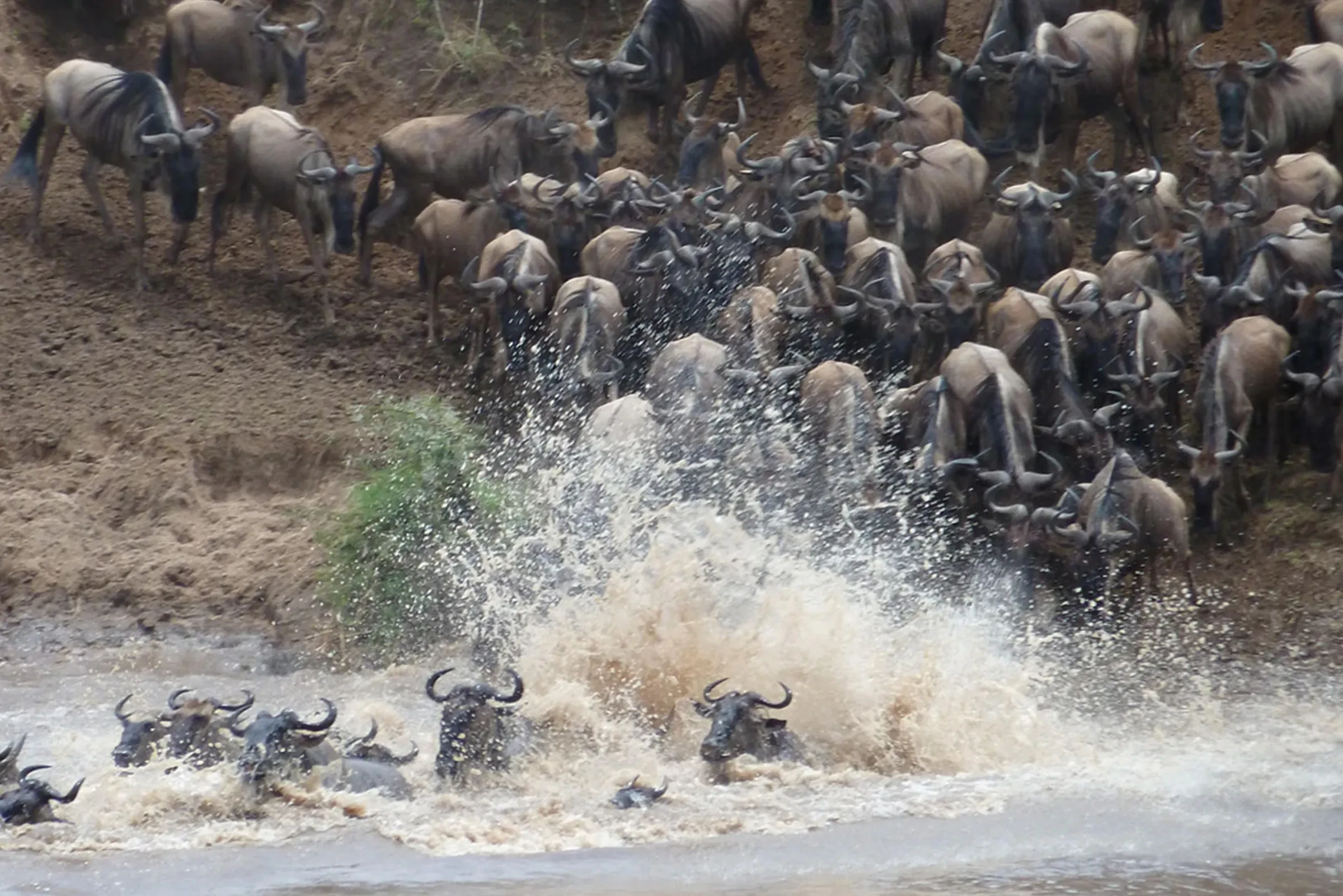
The Serengeti has two great set-pieces. The calving season (roughly January–February) fills the southern short-grass plains with hundreds of thousands of newborn wildebeest — and the predators that follow them, the best big-cat action of the year. The Mara River crossings (roughly July–October) are the migration's most dramatic moment, when the herds mass and plunge across the crocodile-filled river in the northern Serengeti. The long dry season (late June–October) is prime for game viewing across the park; the green season brings lush plains, newborns and fewer vehicles. Big cats are resident every month. Full month-by-month and region-by-region detail in our → Best time to visit the Serengeti guide, and the migration's full annual arc in → Best time to see the great migration.
Things to do here
- Game drives — morning and late-afternoon drives for big cats, plains game and the herds, across whichever region the migration is in.
- Hot-air balloon safari — dawn flights over the plains, a Serengeti signature, followed by a bush breakfast.
- Walking safaris — on foot with an armed guide in designated wilderness zones and private concessions (see → Walking safari).
- Mobile migration camps — light camps that move with the herds through the year, putting you in the heart of the action.
- Maasai cultural visits — genuine, respectful encounters with the communities at the park's edge.
Know before you go
- Getting there: light-aircraft hops from Arusha or Kilimanjaro (JRO) to one of the Serengeti's many airstrips (chosen to match the migration's position), or overland via the Ngorongoro highlands.
- Fees: national park entry fees apply (per person, per day); we confirm current rates and include them in your quote.
- How long: 3–5 nights does the Serengeti justice; combine with Ngorongoro and Tarangire for the full northern circuit.
Related Nobu journeys
- The Great Migration Circuit — the Serengeti timed to your season, calving or crossings. → Explore
- Northern Crater Highlands — the Serengeti paired with the Crater and Tarangire, the classic first safari. → Explore
When to go
Month by month — daytime warmth, days of rain and what the season brings.
Where to stay
From Essential to Private Collection — the camps and lodges we know first-hand here. Rates are indicative and confirmed on enquiry.
Expedition
Olakira Migration Camp
Expeditionmobile camp · reserve (migration-following)
from $600 pp / night· indicative, confirmed on enquiry
Serengeti Safari Camp
Expeditionmobile camp · reserve (migration-following)
from $700 pp / night· indicative, confirmed on enquiry
Elevated
Sayari Camp
Elevatedtented camp · reserve (Mara River)
from $800 pp / night· indicative, confirmed on enquiry
Private Collection
Serengeti Bushtops Camp
Private Collectiontented camp · reserve (north)
from $900 pp / night· indicative, confirmed on enquiry
Journeys through here
Signature routes that pass through Serengeti, Kogatende North — starting points we reshape around your season and pace.
Experiences here
Common questions
- When is the best time to visit the Serengeti?
- It depends what you want: January–February for the calving and big cats on the southern plains, July–October for the Mara River crossings in the north, and the dry season (late June–October) for the easiest all-round game viewing.
- Where is the migration in the Serengeti right now?
- The herds move in a year-round loop — south for the calving early in the year, north toward the Mara River by mid-year. We position your camp to match the herds' expected location for your dates.
- How many days do you need in the Serengeti?
- Three to five nights lets you settle into the right region without rushing; longer if you're chasing the crossings or combining regions.
- Is the Serengeti the same as the Maasai Mara?
- They're one ecosystem across the Tanzania–Kenya border: the Serengeti is the Tanzanian side, the Mara the Kenyan — see our [Maasai Mara vs Serengeti](/guides/maasai-mara-vs-serengeti) comparison.
Tell us what you want from Serengeti, Kogatende North
We'll design the journey around it — places, pace and people matched to how you travel.