Kilimanjaro
Kilimanjaro, in northern Tanzania near the town of Moshi, is Africa's highest mountain and the world's tallest free-standing peak, rising to Uhuru Point at 5,895 metres. It is climbed on foot — no technical equipment required — along established routes such as Machame, Lemosho, Marangu and Rongai, passing through five distinct ecological zones from tropical rainforest to arctic summit. It suits travellers seeking a genuine achievement journey, and pairs naturally with a safari and a Zanzibar recovery.
Why visit
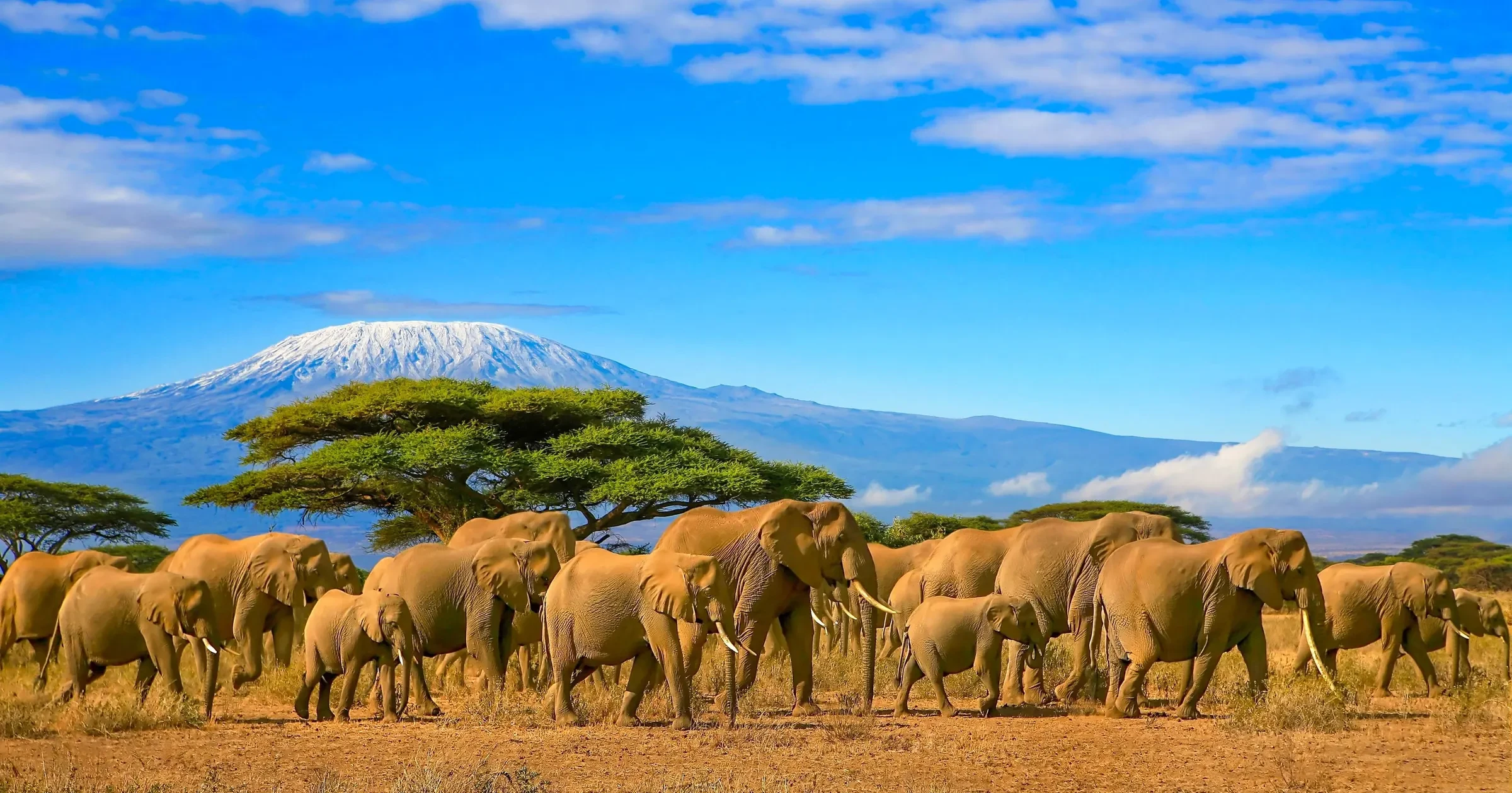
Kilimanjaro is the mountain everyone pictures when they picture Africa — a snow-crowned dome floating above the savannah, visible for a hundred kilometres, standing entirely alone. It is not part of a range. It rises from the plains as a single, impossible massif, which is what makes it the tallest free-standing mountain on earth. To stand at its foot is to feel the scale of it settle into you.
And unlike the great peaks of the Andes or the Himalaya, Kilimanjaro asks no ropes and no technical skill. It is a walk — a long, high, demanding walk, but a walk. That is its quiet genius. An ordinary person, reasonably fit and properly acclimatised, can climb to a point higher than any place in Africa and watch the sun come up over the curve of the continent.
What you carry down is not the summit alone. It is the passage through it: the way the mountain changes beneath your boots from jungle to moorland to alpine desert to ice, an entire journey of climate and landscape compressed into a handful of days.
Wildlife & landscapes
Kilimanjaro's signature is not a game drive — it is the ascent through five ecological zones, stacked one above the next like a cross-section of the planet. You begin in cultivated farmland on the lower slopes, climb into dense montane rainforest, emerge onto open heath and moorland of giant lobelia and groundsel, cross a high alpine desert of bare rock and thin air, and finish in the arctic summit zone of glaciers and permanent ice at Uhuru Point, 5,895 metres above the sea.
The wildlife lives mainly in that lower rainforest belt, and it is a genuine draw on the first day of the walk. The forest is home to black-and-white colobus monkeys leaping through the canopy, troops of blue monkeys, bushbuck, and a rich birdlife including turacos and sunbirds. Elephant and buffalo range the forest too, though they are seldom seen by trekkers on the main routes. Higher up, life thins out with the oxygen — a few hardy ravens and the strange, sculptural endemic plants of the moorland are your companions toward the top.
The glaciers themselves are part of the story: ancient ice near the equator, shrinking year on year, giving the summit its unmistakable white crown against a sky that turns from blue to black as you climb.
Best time to visit
Kilimanjaro is climbed year-round, but the two dry seasons give the clearest skies, the most stable footing and the highest summit-success rates. The long dry window runs January to mid-March — often warmer, quieter on the mountain, with beautiful visibility — while June to October is the busiest and most reliable season, cool and dry, coinciding with the northern-hemisphere summer.
The long rains (late March to May) and the short rains (November) bring cloud, mud and slippery forest trails; some travellers accept them for a quieter mountain, but the trade-off is real. Whatever the month, the summit is arctic — expect well below freezing at Uhuru at dawn, regardless of the season on the plains below.
Things to do here
- Choose your route — the walk itself is the experience, and the route shapes it. Machame ("Whisky route") is scenic and popular; Lemosho is longer, wilder and prized for its acclimatisation profile; Marangu ("Coca-Cola route") is the only hut-based option; Rongai approaches from the drier north.
- Summit night to Uhuru Point — the midnight start, the slow switchbacks by headlamp, and sunrise from the roof of Africa at 5,895 metres.
- Forest walking — the first day's ascent through montane rainforest is a walking experience in its own right, alive with colobus and blue monkeys (see → Walking safari).
- Acclimatisation day hikes — the deliberate "climb high, sleep low" excursions built into longer itineraries, and the single most important factor in reaching the top.
- Pair with a safari and the coast — most travellers frame the climb as one chapter, adding the northern safari circuit and a Zanzibar recovery on the ocean afterward.
Know before you go
- Getting there: Fly into Kilimanjaro International Airport (JRO), which sits between Moshi and Arusha and receives direct flights from several European and East African hubs. Road transfers to your pre-climb base run under an hour.
- Fees: Kilimanjaro National Park charges conservation, camping and rescue fees per day, and these form a significant part of any climb; we confirm the current schedule and include it in your quote.
- How long: Give the mountain the days it deserves — 6 to 8 days on the mountain dramatically improves both acclimatisation and summit success over shorter, rushed ascents. The extra nights are not indulgence; they are what get you to the top safely.
- Pairing: Kilimanjaro sits within reach of the northern safari circuit — Amboseli across the border in Kenya offers the classic view of the peak — and a Zanzibar finale turns an achievement into a complete journey.
Related Nobu journeys
- Elephants and the Mountain — the great herds of Amboseli beneath Kilimanjaro's snows, the mountain seen from its most famous vantage. → Explore
- On Foot and in the Saddle — a walking-led East Africa journey for travellers who want the land underfoot. → Explore
- Bush to Beach — the classic pairing: the wild interior, then the Indian Ocean to recover. → Explore
When to go
Month by month — daytime warmth, days of rain and what the season brings.
Where to stay
From Essential to Private Collection — the camps and lodges we know first-hand here. Rates are indicative and confirmed on enquiry.
Expedition
Africa Amini Maasai Lodge
Expeditionlodge · Maasai grasslands
from $150 pp / night· indicative, confirmed on enquiry
Ndarakwai Ranch Camp
Expeditiontented camp · private conservancy (Ndarakwai)
from $300 pp / night· indicative, confirmed on enquiry
Elevated
Kambi ya Tembo
Elevatedtented camp · private conservancy (Sinya)
from $300 pp / night· indicative, confirmed on enquiry
Private Collection
Shu'mata Camp
Private Collectiontented camp · private conservancy (Sinya)
from $450 pp / night· indicative, confirmed on enquiry
Common questions
- How high is Kilimanjaro and how hard is the climb?
- The summit, Uhuru Point, stands at 5,895 metres, the highest point in Africa. No technical climbing skill is needed — it is a walk — but the altitude makes it genuinely demanding; reasonable fitness and proper acclimatisation matter far more than mountaineering experience.
- How many days do you need to climb Kilimanjaro?
- Six to eight days on the mountain is strongly advised. The extra nights allow your body to acclimatise to the thinning air, which is the single biggest factor in reaching the summit safely; shorter ascents carry markedly lower success and higher altitude-sickness risk.
- Which Kilimanjaro route is best?
- It depends on your priorities. Lemosho is longer and offers an excellent acclimatisation profile; Machame is scenic and popular; Marangu is the only hut-based route; Rongai approaches from the quieter, drier north. Your travel designer will match the route to your fitness and the days you have.
- What is the best time to climb Kilimanjaro?
- The dry seasons: January to mid-March, and June to October. Both give clearer skies, more stable trails and higher summit-success rates than the rainy months of April–May and November.
- What wildlife will I see on Kilimanjaro?
- The lower rainforest zone holds black-and-white colobus and blue monkeys, bushbuck and rich birdlife; higher up, life thins with the altitude. The mountain's real spectacle is its five ecological zones, from jungle to arctic summit.
- Can I combine Kilimanjaro with a safari?
- Yes, and most travellers do. The climb pairs naturally with the northern safari circuit — Amboseli gives the iconic view of the peak — and with a Zanzibar recovery on the coast afterward.
Tell us what you want from Kilimanjaro
We'll design the journey around it — places, pace and people matched to how you travel.