Lake Kivu
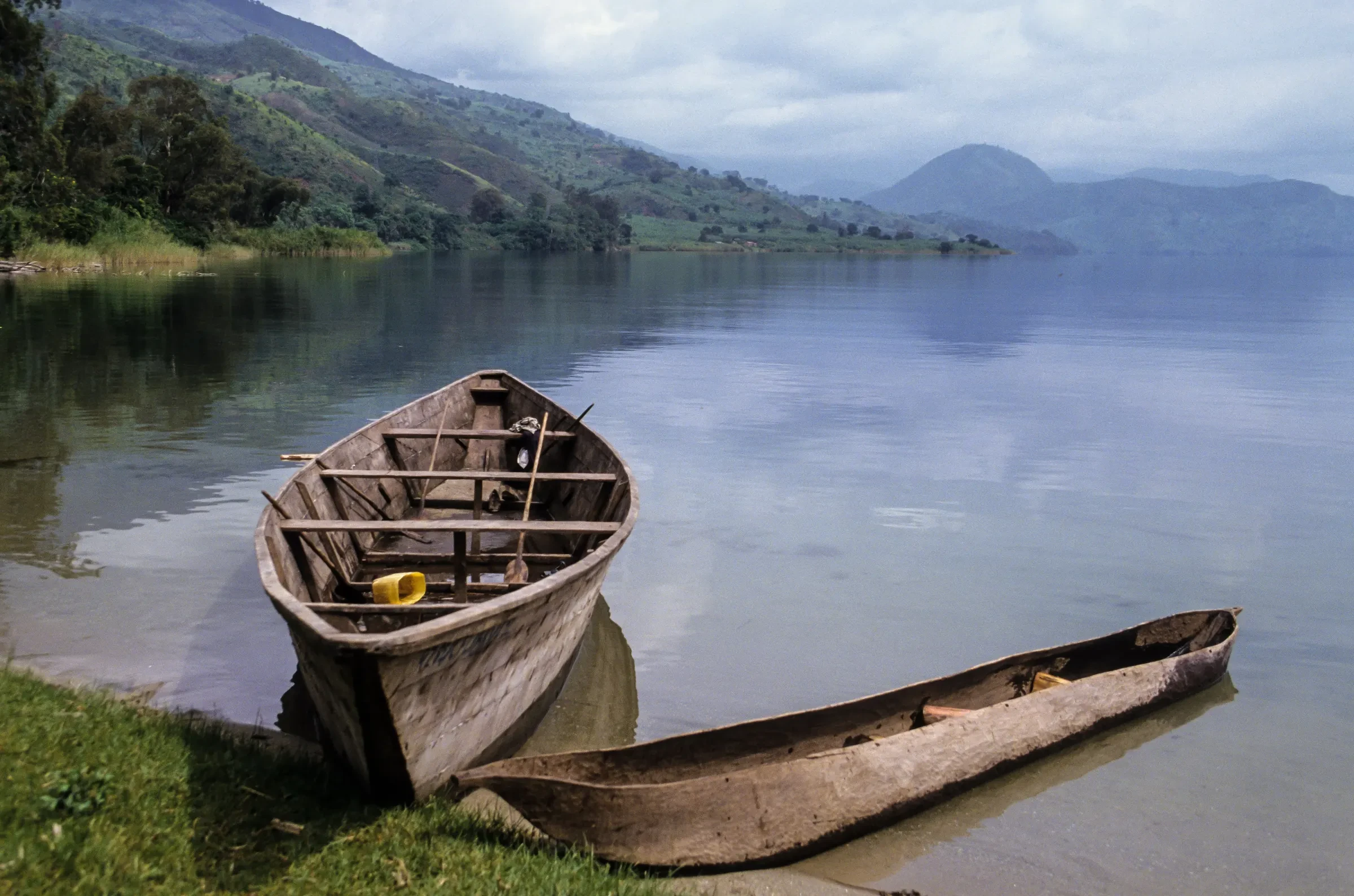
Lake Kivu is one of the African Great Lakes, set in the Albertine Rift along Rwanda's western border with the Democratic Republic of Congo. Ringed by terraced green hills and dotted with small islands, it offers calm, bilharzia-free swimming, kayaking and boat trips, coffee-island visits and the Congo Nile Trail. With no crocodiles or hippos in its deep waters, it is Rwanda's most restful destination — the natural place to decompress after gorilla trekking in the Volcanoes and forests to the north.
Why visit
After days spent climbing through bamboo and cloud forest in search of gorillas, the body asks for stillness. Lake Kivu is where Rwanda gives it. One of the great lakes of the Rift Valley, it stretches for miles between terraced hillsides, its surface catching the light in long silver bands at dawn and dusk. Fishermen sing across the water in the early hours, their tripled canoes moving in slow procession. The pace here is different, and deliberately so.
This is the natural finish to an active Rwanda itinerary. The lake sits within easy reach of Volcanoes National Park, so the transition from the high, hard-won drama of gorilla trekking to the soft ease of the water can happen in an afternoon's drive. The lakeside towns — Rubavu (Gisenyi) in the north, Karongi (Kibuye) in the middle — offer a gentle rhythm of swimming, boat trips and unhurried afternoons.
And the lake rewards the eye as much as it rests the traveller. Small islands rise from the water, some given over to coffee, and the shoreline folds into the famous thousand hills. It is a landscape that asks nothing of you but to slow down and take it in.
Wildlife & landscapes
Lake Kivu is a landscape of water and terraced hills rather than big game, and that is precisely its character. Its deep, calm waters are free of crocodiles and hippos, which makes swimming safe and easy along the shore — a rarity among African lakes. The lake is fringed by steep green hillsides carved into cultivation terraces, the classic scenery of Rwanda's pays des mille collines — the land of a thousand hills.
Scattered across the surface are small islands, several of them planted with coffee and reachable by boat; a slow morning of island-hopping is one of the lake's quiet pleasures. The shoreline itself moves between fishing villages, papyrus fringes and quiet coves.
For birdlife, the lake and its margins are gently rewarding — cormorants and kingfishers work the water, weavers and sunbirds move through the lakeside trees, and pied and malachite kingfishers are among the shoreline regulars. This is birding at an easy pace, a fitting complement to the forest species logged further north. Above the water, the terraced hills roll away toward the volcanoes on the horizon, a landscape that is cultivated, lived-in and quietly beautiful.
Best time to visit
Rwanda's climate is defined by rainfall rather than temperature, and Lake Kivu follows the national pattern. The long dry season (June to September) brings the most reliable sun, calm water and the easiest conditions for swimming, boat trips and the Congo Nile Trail — and it aligns neatly with the prime gorilla-trekking window, which is why most journeys reach the lake in these months. The short dry season (December to February) is a second bright, settled window.
The rains (March to May and October to November) bring greener hills and softer light, with showers that tend to pass rather than settle in; the lake remains pleasant, and travellers who don't mind a passing downpour often prefer the quieter feel. Because Kivu is a decompression stop rather than a wildlife-timed destination, it works well in any season. For how the lake fits the wider trip, see our → Best time to visit Rwanda guide.
Things to do here
- Swimming and lakeside rest — the calm, bilharzia-managed water and hippo- and crocodile-free shoreline make Kivu one of the few African lakes designed for simply slowing down.
- Boat trips and island-hopping — half-day cruises to the coffee islands, bird-rich inlets and quiet fishing villages, often timed for a golden-hour return.
- Kayaking and canoeing — paddling the sheltered bays around Rubavu and Karongi is one of the gentlest ways to feel the scale of the lake (see → Water and canoe safari).
- The Congo Nile Trail — the long-distance hiking and cycling route that traces the lake's eastern shore, walkable in short scenic sections or ridden over several days.
- Coffee-island visits — stepping ashore to see how the lake's coffee is grown and processed, a small, grounded encounter.
- Birding along the shore — an easy, rewarding add for anyone carrying binoculars from the forests (see → Birding safari).
Know before you go
- Getting there: The lake sits on Rwanda's western edge. Rubavu (Gisenyi) is roughly a 1 to 1.5 hour drive from Volcanoes National Park, making it the easiest post-gorilla transition; Karongi (Kibuye) is more central. Kamembe Airport (KME) near Rusizi serves the southern lake, and Kigali (KGL) is the main international gateway, around three hours by road.
- Fees and access: Some activities — boat trips, the Congo Nile Trail, coffee-island visits — carry local fees; we confirm current requirements and include them in your quote.
- How long: 2 to 3 nights is the natural length for a decompression stop after trekking; longer if you want the lake to be a genuine chapter rather than a pause.
- Pairing: Kivu pairs most naturally with Volcanoes National Park to the north and, for travellers heading south, with Nyungwe's rainforest — the classic active-then-restful arc of a Rwanda journey.
Related Nobu journeys
When to go
Month by month — daytime warmth, days of rain and what the season brings.
Where to stay
From Essential to Private Collection — the camps and lodges we know first-hand here. Rates are indicative and confirmed on enquiry.
Essential
Bethany Investment Hotel
Essentialhotel · lakeshore
from $50 pp / night· indicative, confirmed on enquiry
Signature
Moriah Hill Resort
Signatureresort · lakeshore
from $80 pp / night· indicative, confirmed on enquiry
Paradis Malahide
Signaturelodge · lakeshore
from $80 pp / night· indicative, confirmed on enquiry
Expedition
Inzu Lodge
Expeditiontented camp · lakeshore
from $80 pp / night· indicative, confirmed on enquiry
Elevated
Cleo Lake Kivu Hotel
Elevatedhotel · lakeshore
from $150 pp / night· indicative, confirmed on enquiry
Cormoran Lodge
Elevatedlodge · lakeshore
from $150 pp / night· indicative, confirmed on enquiry
Lake Kivu Serena Hotel
Elevatedresort · lakeshore
from $180 pp / night· indicative, confirmed on enquiry
Common questions
- Can you swim in Lake Kivu?
- Yes. Lake Kivu has no crocodiles or hippos, and bilharzia is actively managed along the main swimming areas, so it is one of the few African lakes where open swimming from the shore is genuinely easy and safe.
- Why visit Lake Kivu after gorilla trekking?
- Gorilla trekking is physically demanding, and the lake sits close to Volcanoes National Park — around an hour to Rubavu (Gisenyi). It gives you a calm, restful place to unwind at the end of an active Rwanda itinerary.
- How many nights do you need at Lake Kivu?
- Two to three nights is ideal as a decompression stop; a little longer if you want to hike or cycle part of the Congo Nile Trail or make the most of island-hopping.
- What is there to do at Lake Kivu?
- Swimming, boat trips and island-hopping to the coffee islands, kayaking, birding along the shore, and walking or riding sections of the Congo Nile Trail that traces the lakeshore.
- Which town on Lake Kivu should I stay in?
- Rubavu (Gisenyi) in the north is closest to Volcanoes National Park and the easiest post-trek stop; Karongi (Kibuye) is quieter and more central. Your travel designer will match the town to your route.
Tell us what you want from Lake Kivu
We'll design the journey around it — places, pace and people matched to how you travel.