Kendwa
Kendwa is a beach on the north-west tip of Zanzibar (Unguja island), Tanzania, immediately south of Nungwi, known for a rare stretch of shoreline where tidal retreat is minimal and swimming is possible through the day. Facing due west, it delivers Zanzibar's finest sunsets, a relaxed and spread-out beach scene, established dive schools, and the island's best-known full-moon gathering — making it the calmer, more open counterpart to its busier neighbouring village.
Why visit
Most of Zanzibar asks you to read a tide chart before you plan your day. Kendwa does not. It shares the rare gift of the island's northern tip — a tidal pattern that keeps the water close and swimmable from morning to evening — but it wears that gift more loosely than the fishing village just to the north. Here the sand runs wide and open, the properties sit back from one another, and the pace slows to the speed of the water.
If Nungwi is the working village with its dhow yards and dawn boats, Kendwa is its unhurried younger sibling a short walk down the coast. The same clear, all-day sea; a softer, more spacious feel. You come here to swim, to dive, to do very little with great commitment — and to watch the light change.
And the light is the thing. Kendwa faces due west across an open horizon, which makes its sunsets the most reliable and the most complete on the island: the sun does not slip behind a headland or a village, it lowers itself straight into the Indian Ocean. On the night of a full moon, the beach gathers for its famous celebration under a bright sky — a Kendwa institution that draws travellers up from across the coast.
Reef, ocean & marine life
The draw at Kendwa is the water itself, and it runs deep in more ways than one. The north-west corner of Zanzibar is sheltered from the south-east monsoon winds that roughen the east coast, which gives Kendwa calmer seas and a longer diving and snorkelling window across the year. It is one of the reasons the beach has grown into a genuine dive base, with established schools running courses and guided dives from the sand.
Offshore, the reefs of the north and north-west fringe support reef fish in abundance — parrotfish, snapper, triggerfish, moray eels — and, in season, turtles and rays moving through. Boats from Kendwa run north and east to the richer marine environment of Mnemba Atoll and its surrounding marine park, where visibility opens up and the reef life becomes denser still. Dolphins are frequently sighted along the north coast, and the deeper channels off this tip draw divers looking for larger pelagic species.
Because the sea stays swimmable through the whole tidal cycle, the ocean at Kendwa is not a scheduled activity — it is simply always there. That constant, clear water is what sets this coast apart, and it is what the marine life rewards, whether you are a first-time snorkeller floating over the shallows or a diver dropping onto a reef wall offshore.
Best time to visit
Zanzibar's seasons follow the monsoon, not the savannah. The dry season from June to October is the clearest window — calm seas, dependable sun, and the best underwater visibility for reef diving. December to February is warm and largely dry, and among the most comfortable times to be on the north coast. The long rains (March to May) bring heavy downpours and rougher water that can limit boat trips and diving; the short rains around November are lighter and more intermittent.
Kendwa's all-day swimmability means the beach stays usable even in shoulder months when tidal beaches sit exposed at low water. If you want to catch the full-moon gathering, time your nights to the lunar calendar. For the fuller picture — including how to pair a Zanzibar stay with a mainland safari — see our → Best time to visit Zanzibar guide.
Things to do here
- Diving and reef snorkelling — Kendwa's established dive schools run courses and guided dives; day trips by boat reach Mnemba Atoll and the surrounding marine park (see → Water and canoe safari).
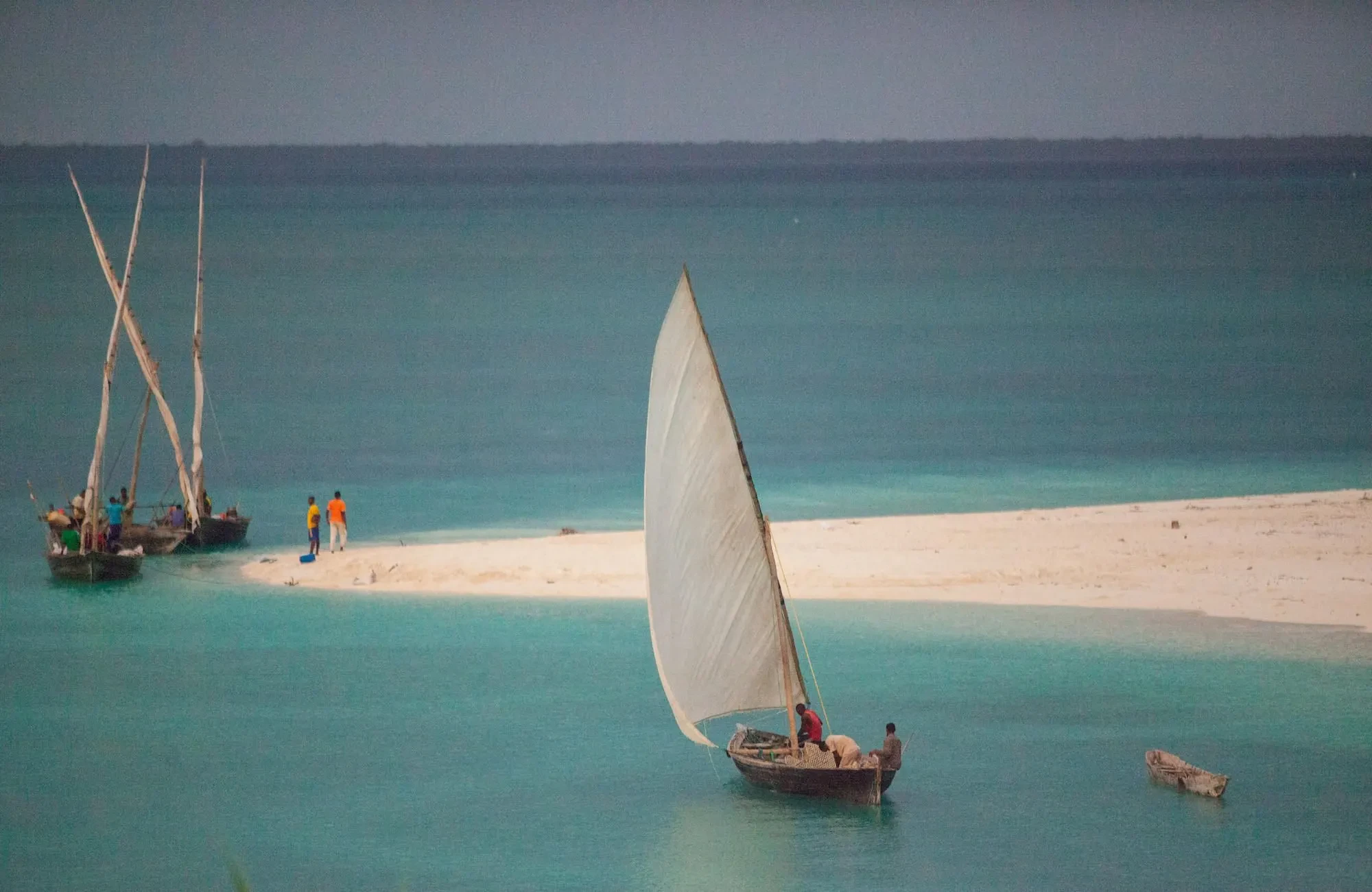
- Sunset dhow cruises — a traditional wooden dhow at dusk on a west-facing sea is the defining Kendwa image (see → Dhow and the Swahili Coast).
- The full-moon gathering — the beach's best-known event, held under a bright open sky; a relaxed, sociable Kendwa institution.
- All-day swimming — the whole point of this coast: clear water at the shore through the full tidal cycle, no timetable required.
- Watersports — kayaking and stand-up paddleboarding suit the calmer north-coast waters; deep-sea fishing charters run from the beach.
- Nungwi and Stone Town excursions — the working village of Nungwi is a short trip up the coast, and Zanzibar's UNESCO-listed old quarter is roughly an hour and a half south for a half-day of Swahili, Arab and Portuguese history.
Know before you go
- Getting there: Fly into Zanzibar International Airport (ZNZ), which receives direct flights from Nairobi, Dar es Salaam and other East African hubs. Kendwa sits at the far north-west tip of Unguja, just south of Nungwi — transfers run approximately 1 to 1.5 hours by road from the airport.
- Entry and fees: Tanzania visa requirements apply; a beach-conservation levy may be collected locally — we confirm current requirements and include them in your planning.
- How long: 3 to 4 nights suits Kendwa well as a self-contained beach stay; 5 to 7 nights is comfortable if Zanzibar is the main focus. It pairs naturally with a Tanzania or Kenya safari for a bush-and-beach journey.
- Character note: Kendwa is relaxed and spread out — quieter than Nungwi, with a laid-back scene and the full-moon gathering as its lively exception. For the working-village texture and dhow yards nearby, → Nungwi is a short trip up the coast.
Related Nobu journeys
- Shores of Zanzibar — the north-coast beaches at their fullest: reef, dhow, sunsets, and the spice island's layered story. → Explore
- Bush to Beach — a classic East Africa pairing: safari on the plains, then the Indian Ocean. → Explore
- Southern Safari and Spice — the southern Tanzania parks combined with Zanzibar's coast, for travellers who want the full range. → Explore
When to go
Month by month — daytime warmth, days of rain and what the season brings.
Where to stay
From Essential to Private Collection — the camps and lodges we know first-hand here. Rates are indicative and confirmed on enquiry.
Essential
Kendwa Rocks Hotel
Essentialhotel · beachfront
from $50 pp / night· indicative, confirmed on enquiry
Sunset Kendwa Beach Hotel
Essentialhotel · beachfront
from $70 pp / night· indicative, confirmed on enquiry
Signature
Canary Kendwa Beach Resort
Signatureresort · beachfront
from $80 pp / night· indicative, confirmed on enquiry
Diamonds La Gemma dell'Est
Signatureresort · beachfront
from $150 pp / night· indicative, confirmed on enquiry
Sansi Kendwa Beach Resort
Signatureresort · beachfront
from $90 pp / night· indicative, confirmed on enquiry
Elevated
Zuri Zanzibar
Elevatedresort · beachfront
from $300 pp / night· indicative, confirmed on enquiry
Private Collection
Gold Zanzibar Beach House & Spa
Private Collectionresort · beachfront
from $350 pp / night· indicative, confirmed on enquiry
Kilindi Zanzibar
Private Collectionresort · beachfront
from $500 pp / night· indicative, confirmed on enquiry
Journeys through here
Signature routes that pass through Kendwa — starting points we reshape around your season and pace.
Common questions
- Why can you swim all day at Kendwa?
- Kendwa shares the north-west tip's tidal pattern, where the sea stays close to the shore throughout the day. Much of Zanzibar's east coast sees significant tidal retreat that leaves wide, exposed sandflats at low water; Kendwa's geography keeps swimmable water at the beach across the full tidal cycle.
- What's the difference between Kendwa and Nungwi?
- They sit side by side on the same north-west tip and share the same all-day sea, but Nungwi is the busier working village with dhow yards and dawn fishing boats, while Kendwa is calmer, more open and spread out, with west-facing sunsets and a laid-back scene. See → [Nungwi](/destinations/zanzibar/nungwi).
- Is Kendwa good for diving?
- Yes. Sheltered from the south-east monsoon, the north-west corner has calmer seas and a long diving window, and Kendwa has established dive schools on the beach. Boats reach the richer reefs of Mnemba Atoll and its marine park.
- When can you see the full-moon party at Kendwa?
- Kendwa's well-known full-moon gathering is held to the lunar calendar; time your nights to a full moon if you want to catch it, and your travel designer can align your stay.
- How far is Kendwa from Zanzibar airport?
- The transfer runs approximately one to one and a half hours by road from Zanzibar International Airport (ZNZ) in the south of the island up to the north-west tip.
- Can I pair Kendwa with a safari?
- Easily. Zanzibar works as a natural three-to-five day finale to a Tanzania or Kenya safari, with ZNZ well connected to Nairobi and Dar es Salaam. See our [Bush to Beach](/journeys/bush-to-beach) journey.
Tell us what you want from Kendwa
We'll design the journey around it — places, pace and people matched to how you travel.