Start here
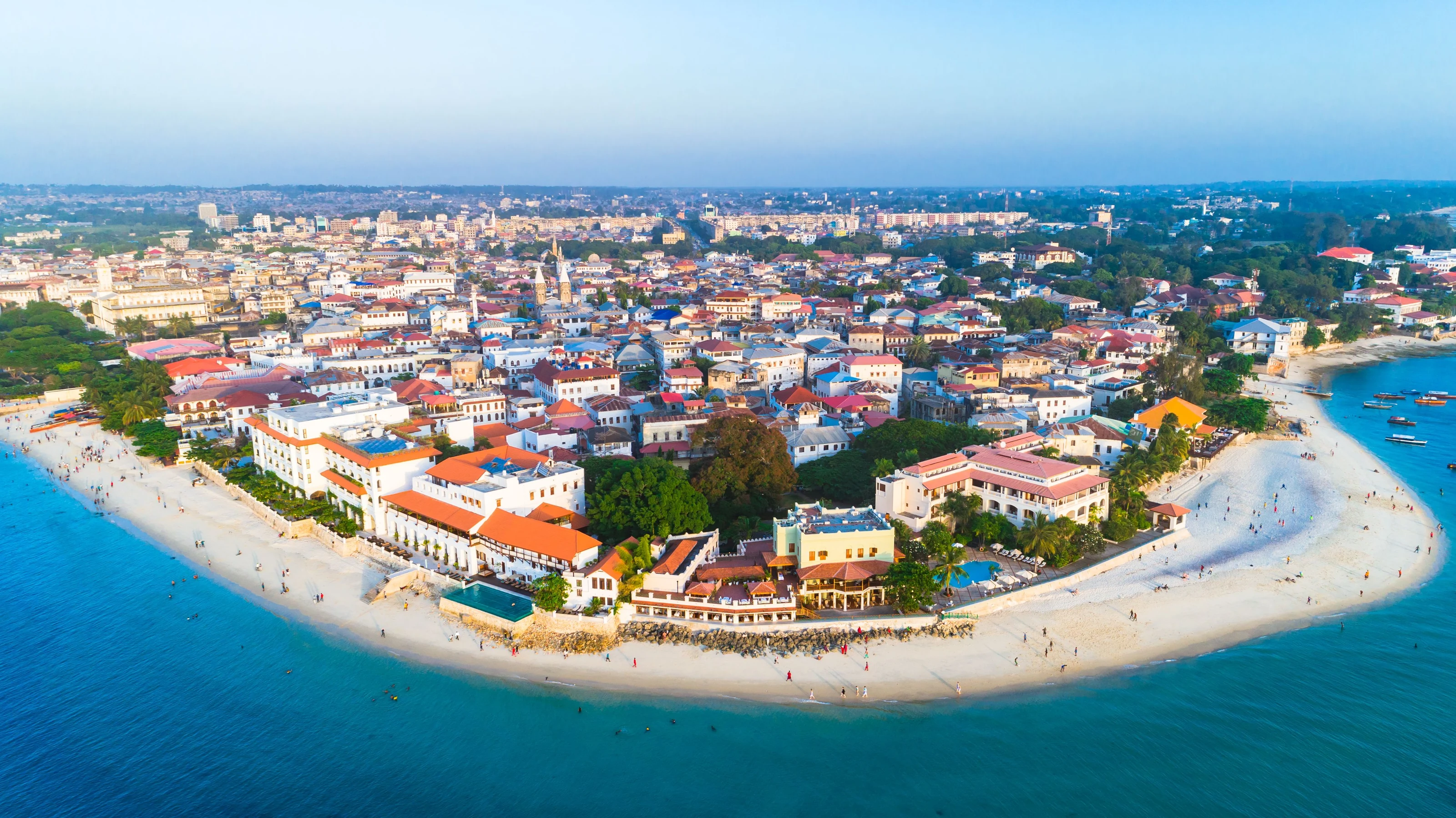
Stone Town history is easier to see than to summarise. The town is a short walk across, yet its walls hold several centuries: a fort raised against the Portuguese, a palace fitted with electric light and a lift in 1883, a cathedral built on the ground where people were sold, and the carved doors of merchants who financed it all. Coral rag and lime plaster make everything look the same age. It isn't.
The way to understand the town is building by building. These ten are chosen because, together, they tell the sequence in order: power, trade, its human cost, and the long effort to keep a fragile town standing. Two of the ten are not single buildings: Forodhani is a garden, and the merchant door stands for the carved doors of many houses. For the walk itself, with timings and a guide, use our Stone Town guided walk; this page is the story you carry with you.
The story
Before the sultans: 1. The Old Fort (Ngome Kongwe). Excavations in the fort's courtyard in 2017 and 2018 found a Swahili settlement by the beach from the 11th century, with household walls and imported pottery; some accounts push the start back to the late 10th century. The oldest large structure on the seafront is an Omani fort raised around a Portuguese chapel after Oman drove the Portuguese from the coast. Sources date its completion between 1698 and 1701. It later served as a garrison and prison, then as a depot for the railway to Bububu in the early twentieth century. Its courtyard is now a performance space; Sauti za Busara, which had long used it, moved to Mnazi Mmoja Grounds for its 2026 edition. Stand inside the walls and you are standing in the town's first chapter.
The sultan's waterfront: 2. The Palace Museum, 3. the House of Wonders and 4. Forodhani. Sultan Said bin Sultan moved his court from Muscat to Zanzibar (sources give dates from 1824 to 1840), and the seafront became a line of palaces. The Palace Museum (Beit al-Sahel) was a sultans' residence until the revolution of January 1964 and has housed a permanent exhibition on Princess Salme, the sultan's daughter who became Emily Ruete; check whether it is open. Beside it, the House of Wonders (Beit al-Ajaib) was built in 1883 for Sultan Barghash: the first building in Zanzibar with electricity and the first in East Africa with a lift. It came through the British bombardment of 27 August 1896 almost undamaged, while the palace and harem beside it were wrecked. Part of its seaward side collapsed on 25 December 2020, during restoration. Oman is funding the rebuilding, and UNESCO added it to a Stone Town restoration agreement in March 2025. The interior had already been closed since a 2012 balcony collapse. In front, Forodhani was the old landing place before it became a jubilee garden and, after a 2009 restoration, today's evening market; its own story is told in Forodhani Gardens.
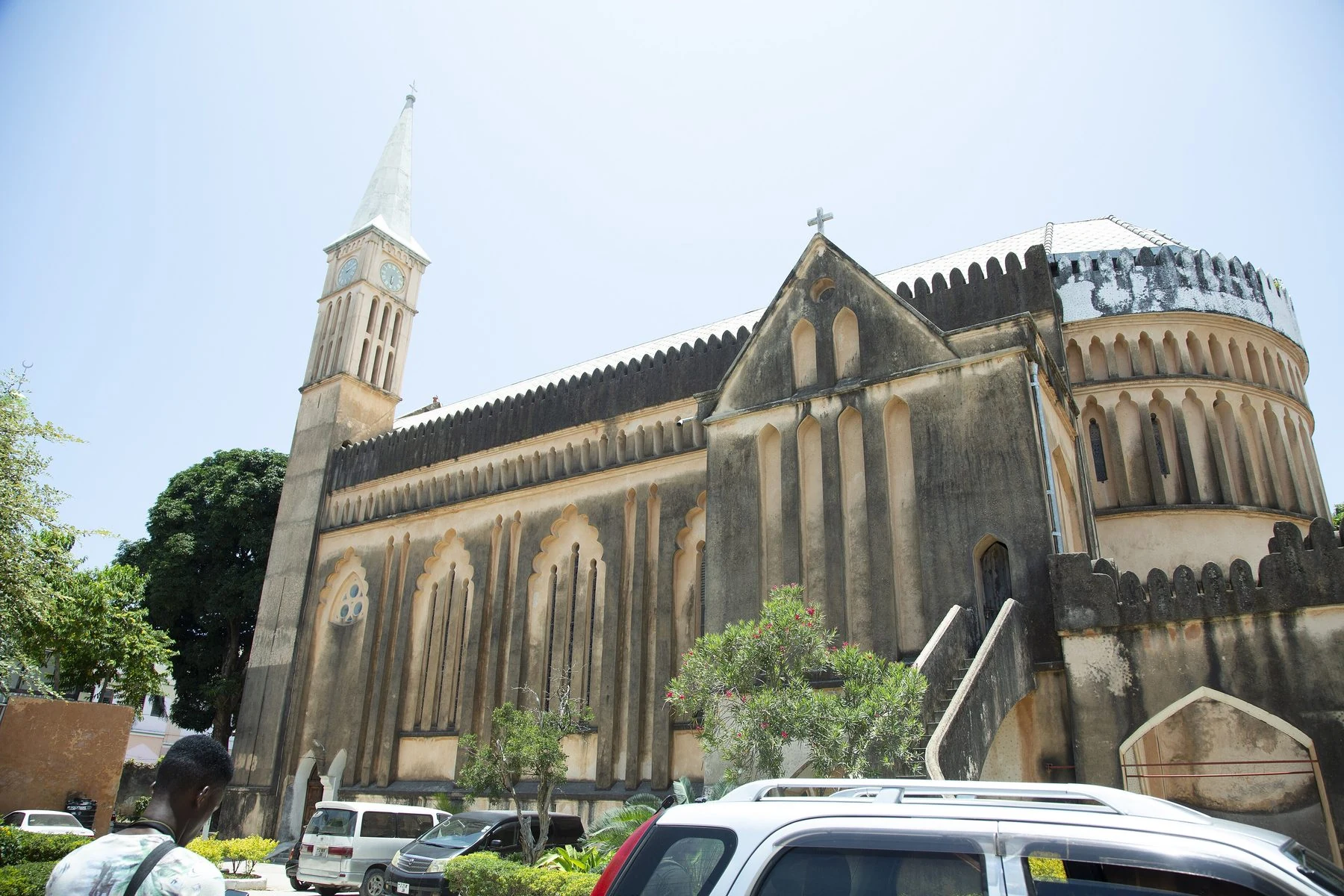
Trade and its price: 5. The Anglican cathedral, 6. Tippu Tip's house and 7. the Hamamni baths. In 1873 Sultan Barghash, under threat of a British naval blockade, closed the town's open slave market. On Christmas Day that year work on Christ Church Cathedral began on the site; according to the Anglican diocese, the building was completed in December 1880. The market and the memorial are treated with the care they need in the slave market and the cathedral. A few lanes away stands the house of Tippu Tip (c. 1832–1905), the best-known ivory and slave trader of his age, later a governor in King Leopold's Congo Free State. It is a private house: look from the lane, and let the plain façade do the work. Nearby, the Hamamni Persian Baths, built between 1870 and 1888 for Barghash by Shirazi builders, were Stone Town's public baths until 1920, a reminder that the same wealth paid for civic comfort.
Merchants, clubs and doors: 8. The Old Dispensary, 9. Africa House and 10. a merchant's door. The Old Dispensary, commissioned in 1887 by the Ismaili merchant Tharia Topan for Queen Victoria's Golden Jubilee and finished in 1894, is the town's most exuberant façade: carved Indian balconies, stained glass and European stucco on a coral-stone core. The Aga Khan Trust for Culture restored it between 1990 and 1994. Africa House, on the Shangani seafront, was the English Club of the colonial years; its current status is unclear. Finish at any merchant house with a carved door, either an arched Indian-style frame studded with brass or a square Omani one with an inscribed lintel. The door was the family's statement to the street, and the carved doors of Zanzibar have their own page.
After 1964: why the town looks tired. Zanzibar became independent on 10 December 1963; the revolution of 12 January 1964 overthrew the sultanate, and in April 1964 the island joined Tanganyika to form Tanzania. Many Arab and Indian families left, death-toll estimates for the revolution vary enormously between sources, and much of the old housing passed to the state. Decades of thin maintenance followed. The conservation authority set up for the old town and the 2000 inscription slowed the losses, but coral rag is soft, roofs leak, and the collapse at the House of Wonders showed how fragile even the grandest buildings are.
Key facts
UNESCO World Heritage inscription: 2000. Oldest standing fortification: the Old Fort, completed between 1698 and 1701 (sources differ). Omani capital: moved from Muscat (sources give dates from 1824 to 1840). House of Wonders: built 1883 for Sultan Barghash; partial collapse 25 December 2020; closed, with no reopening announced as of October 2026. Slave market closed: 1873. Cathedral work began: Christmas Day 1873; completed December 1880 (diocese). British protectorate: 1890. Anglo-Zanzibar bombardment: 27 August 1896. Revolution: 12 January 1964.
How to experience it
In what order. The ten sit within a short walk of each other. For a timed route with a guide, see the Stone Town guided walk. A licensed local guide adds what no plaque does: which family lived where, and what changed after 1964.
What is open. Opening hours and entry fees change, so check the Stone Town conservation authority before you plan.
| Building | Usually open to visitors | Check with |
|---|---|---|
| House of Wonders | Closed; no reopening announced | Stone Town conservation authority |
| Tippu Tip's house | Exterior only; a private house | Look from the lane |
| Anglican cathedral | Open outside services; a working church | Avoid service times unless attending |
| Palace Museum | Not confirmed | Stone Town conservation authority |
| Old Dispensary | Not confirmed | Stone Town conservation authority |
| Hamamni Persian Baths | Not confirmed | Stone Town conservation authority |
| Old Fort | Courtyard used as a performance space | Event listings |
Etiquette. Shoulders and knees covered, as dress and photography etiquette explains. Get permission before photographing people, and treat Tippu Tip's house and the cathedral site as places of memory, not backdrops.
Right for you if… you like to know what you are looking at, you have a night or two in town before the coast, and you can walk two to three hours over uneven stone. If you would rather simply drift through the lanes, the Stone Town destination page and a good rooftop may suit you better than a history-led morning.
Why it matters to how we travel
A beach holiday on Zanzibar is richer for knowing why the island looks the way it does. A travel designer can plan at least one full night in town, put the walk in the cool morning hours and brief your guide to tell the hard chapters plainly. The history is also why the town is fragile. In our view, staying in a restored house and hiring a local guide helps put money where conservation is needed.
Journeys to consider
- Shores of Zanzibar — a night or two in the old town before the coast. → Shores of Zanzibar journey
- Southern Safari & Spice — Tanzania's parks, then Stone Town and the sea. → Southern Safari & Spice journey
- Stone Town, the east coast and Mnemba — ten nights — the longer island journey, with time to read the town slowly. → Ten nights on Zanzibar, the long version