
Start here
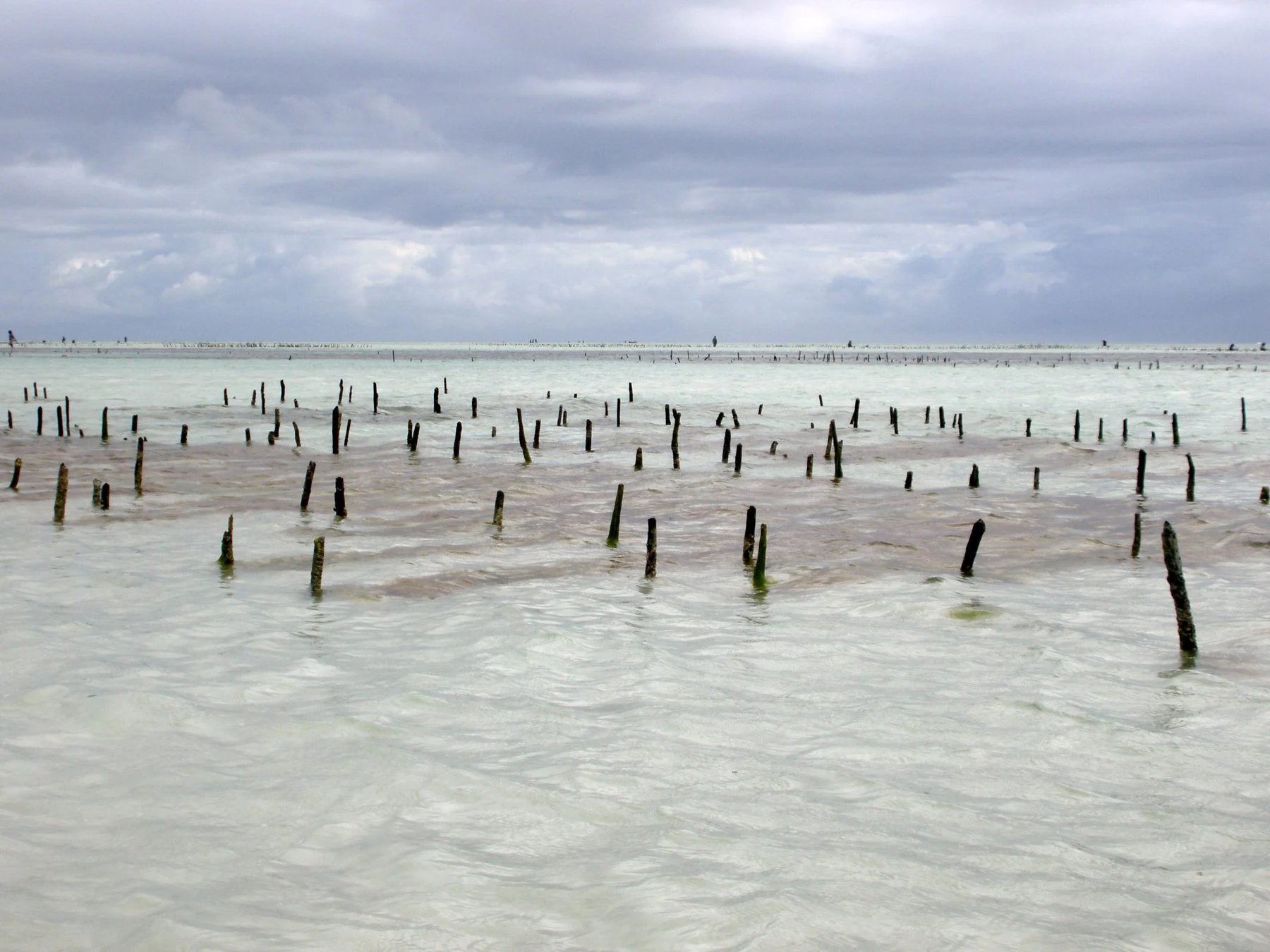
Zanzibar seaweed farming is easiest to see at low water on the east coast, when stakes and ropes resolve into a pattern across the lagoon. Someone has planted that pattern, maintained it and counted on the harvest. The farms are workplaces, visible from a holiday beach but belonging to an economy that extends far beyond it.
Understanding the crop changes how you look at the shore. The useful questions concern the work: how it grows, who buys it, who earns from the finished product. Choosing between the villages is covered by Paje or Jambiani; here, the farmers and their crop hold the story.
The story
A modern industry with an older trade. Zanzibar exported wild-collected seaweed long before anyone planted commercial plots: Flower Msuya's study, published in 2012 from fieldwork in 2010, traces that trade to the 1930s. Cultivation proper began in 1989, when a company based at Jambiani started farming with seedlings imported from the Philippines. Some accounts date wild-seaweed collection to the 1970s rather than the 1930s. Family knowledge runs deep, but the farmed lagoon you see is more than thirty-five years old.
A farm held just above the seabed. Small pieces of seaweed are tied to ropes stretched between wooden stakes. Farmers tend and harvest when the falling water opens the plots, then spread the crop to dry. That makes cultivated seaweed something quite different from the loose weed washed onto a hotel beach: the lines are planted stock, and walking across them damages someone's work. The wider lagoon rhythm belongs to how Zanzibar's tides work.
The two commercial names hide a useful difference. Spinosum is Eucheuma denticulatum; cottonii is usually Kappaphycus alvarezii. Both supply carrageenan, used to thicken and stabilise foods and drinks. Cottonii earns more but suffers most in warm water, so a change of crop can mean a change in household earnings. Most of the harvest is grown on Pemba, which supplies about 80% of Zanzibar's seaweed.
Income, with hard labour attached. Seaweed lets women earn directly and cover household costs. The World Bank counts about 20,000 farmers on the isles in 2024, over 80% of them women, and records a fall from 23,000 in 2011 as prices and disease drove people out. UN reporting names low prices and few chances to process the harvest as the main barriers; Associated Press reporting adds long hours in the sun and the strain of carrying wet harvests. These are growers with expertise, not a picturesque scene for passing cameras.
Climate changes both yields and access. Hotter seawater stresses the crop and encourages ice-ice, a condition that whitens and weakens seaweed. Cooler, deeper water is one answer, but reaching it takes boats, equipment and swimming skills, which the World Bank lists among farmers' needs; moving farms offshore does not automatically help the women who work the shallows. UNDP is developing a climate-risk insurance scheme for seaweed farmers (August 2026); it is not yet in place.
Keeping more value near the shore. Selling a raw crop and making a finished product are different businesses. UN reporting from January 2026 describes women-led groups learning to process seaweed, and better drying facilities protecting harvest quality. In Paje, Mwani Zanzibar says its own farmers and artisans make its soap and skincare, by its own account a route beyond selling raw material.
Key facts
| Began | Commercial farming from 1989; wild seaweed traded from the 1930s |
|---|---|
| Who | About 20,000 farmers in Zanzibar (2024), over 80% women |
| Method | Seaweed tied to ropes between stakes in shallow tidal plots, then sun-dried |
| Main crops | Spinosum and cottonii, both sources of carrageenan |
| Pressures | Warming water, ice-ice disease, low prices |
| Visit | Mwani Zanzibar, Paje: 90 minutes, optional farm element, US$15 on its booking page |
How to experience it
Start with the centre. Mwani Zanzibar's visit page describes a 90-minute visit to its production studio in Paje, with a seaweed drink and the option of seeing the farm. The meeting place, the time and whether the farm element runs that day are worth settling in advance; the farm is optional, so not every visit means walking into the water.
The fee. Mwani lists the visit at US$15 on its booking page. Settle the fee and inclusions when you book, and find out how payment reaches the people hosting you. Buying a locally made product is another way to support processing work; choose something you will actually use.
Let the grower lead. Do not approach a plot because it looks empty, or step over ropes for a photograph. Get permission before entering, touching the crop or photographing anyone, and accept a refusal without negotiating. Agree payment before an organised demonstration; do not expect a farmer to stop harvesting for free. On a permitted lagoon visit, follow the host's route and keep off seaweed, seagrass and live coral. Find out the footing in advance: a studio tour and a tidal walk demand different mobility.
Choose the version before you go.
- Studio visit only: gentle and dry.
- Studio plus farm walk: tide-dependent, with wet footing.
Right for you if you are happy to listen more than photograph, pay a fair fee and follow a host's lead at a working site. Not for you if you want a lagoon photo opportunity, are short on time, or have limited mobility and were hoping for the tidal walk; the studio alone is the gentler option.
Keep village visits modestly dressed; dress and photography etiquette covers the wider guidance. If other working traditions interest you, read about a Swahili cooking class, the spice farm visit and a guided Stone Town walk.
Why it matters to how we travel
A story-led journey should make the people behind a landscape easier to understand. Here that means letting farmers set the terms of a meeting, valuing what they know and asking where visitor spending goes. If a seaweed visit suits your journey, a travel designer checks who is hosting, what it costs and where the money goes before suggesting it.
Journeys to consider
- Shores of Zanzibar — an island journey with room to understand a working coast. → Shores of Zanzibar journey
- Southern Safari & Spice — Tanzania's wildlife country and Zanzibar's shore, connected through the people who live in each landscape. → Southern Safari & Spice journey